
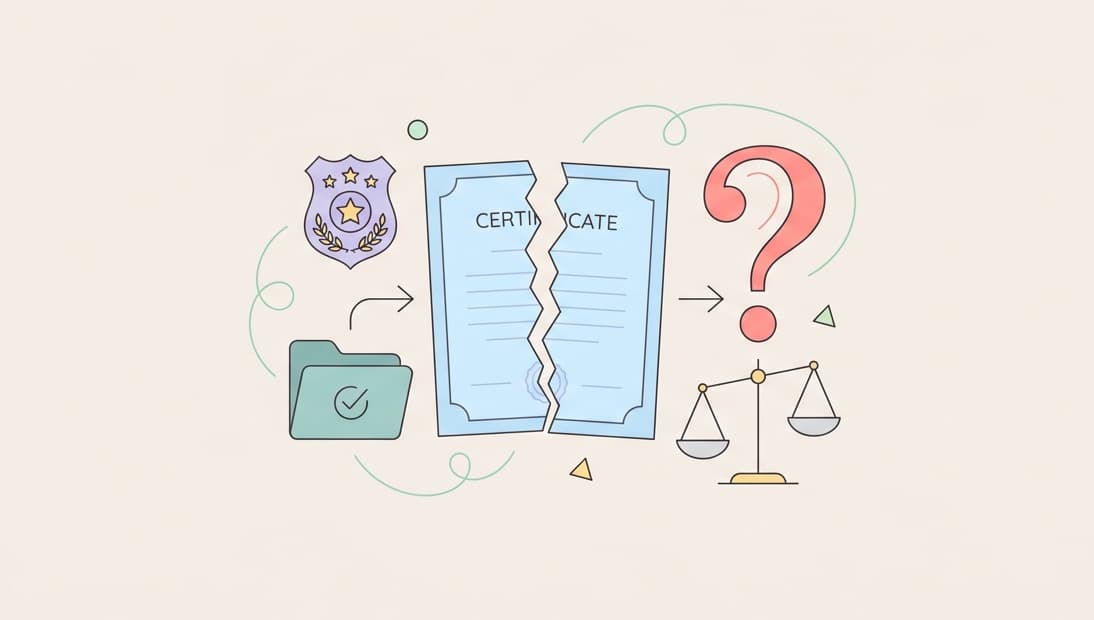
When you lose your Indian birth certificate, many online sources say "file an FIR first." Is that actually required? The answer depends on the issuing authority and your specific circumstances. This guide cuts through the confusion.
Is an FIR mandatory before applying for a duplicate birth certificate?
No, not universally. FIR (First Information Report) requirements vary by Municipal Corporation and state. Most digitised authorities (MCD Delhi, BMC Mumbai, BBMP Bengaluru) do not require an FIR — they accept a notarised affidavit of loss. Some older paper-based Panchayat offices may insist on an FIR or at least a police complaint copy. We confirm the requirement with the specific issuing authority before your application.
Can an NRI file an FIR from abroad for a lost birth certificate?
Direct FIR filing requires presence at the police station, so an NRI cannot file FIR remotely from abroad. However, you can file an online complaint or e-FIR in many Indian states. Most state police websites accept online complaints for missing documents — these often serve as substitutes for a physical FIR. Alternatively, our team can file the complaint or FIR on your behalf in India after you give us a notarised authorisation letter.
What's the difference between an FIR and a police complaint for lost documents?
An FIR (First Information Report) is filed for cognisable offences and triggers a formal police investigation. A police complaint or non-cognisable report (NCR) is a simpler record of a non-criminal incident — typical for lost documents (which isn't an offence, just an inconvenience). For lost birth certificates, what you usually need is an NCR or a lost-document complaint, not a full FIR. The police station issues a stamped acknowledgment, which is what Municipal authorities accept.
If I lost my birth certificate abroad, do I need to file an FIR there?
This is sometimes asked. If the Indian Municipal authority specifically requires proof of loss, a police complaint or report from your current country of residence (USA, UK, Canada, etc.) is generally accepted — provided it's notarised and apostilled. Alternatively, an affidavit of loss notarised in your country and apostilled is sufficient for most authorities. We advise on which route to take based on the issuing authority's current practice.
What does the affidavit of loss say?
A standard affidavit of loss states: deponent's identity (your name, age, address, passport number); description of the lost document (birth certificate issued by [authority] on [date]); circumstances of loss (when, where, how the certificate was lost or destroyed); a declaration that you have not used the lost certificate for any wrongful purpose; a declaration that if found, you will surrender it to the issuing authority; verification clause; signature; notary attestation. We drafted this affidavit for you.
Will I be in legal trouble if I cannot show an FIR?
No. Loss of a personal document is not a punishable offence in India. The FIR or police complaint, where required, serves administrative purposes — to confirm that the loss has been reported and to discourage frivolous duplicate requests. There is no penalty for not having filed an FIR if the Municipal authority accepts an affidavit instead.
Does the police verification take long?
If an FIR or police complaint is filed, the police verification at the station typically takes a few hours to a couple of days. The stamped acknowledgement is issued immediately upon filing. The Municipal Corporation's processing of the duplicate then runs in parallel — the FIR is just one supporting document, not a bottleneck.
India For NRI is India's #1 expert service for obtaining Indian birth certificates — trusted by 10,000+ NRIs across 50+ countries for apostille, NABC, name correction, and all birth certificate needs