
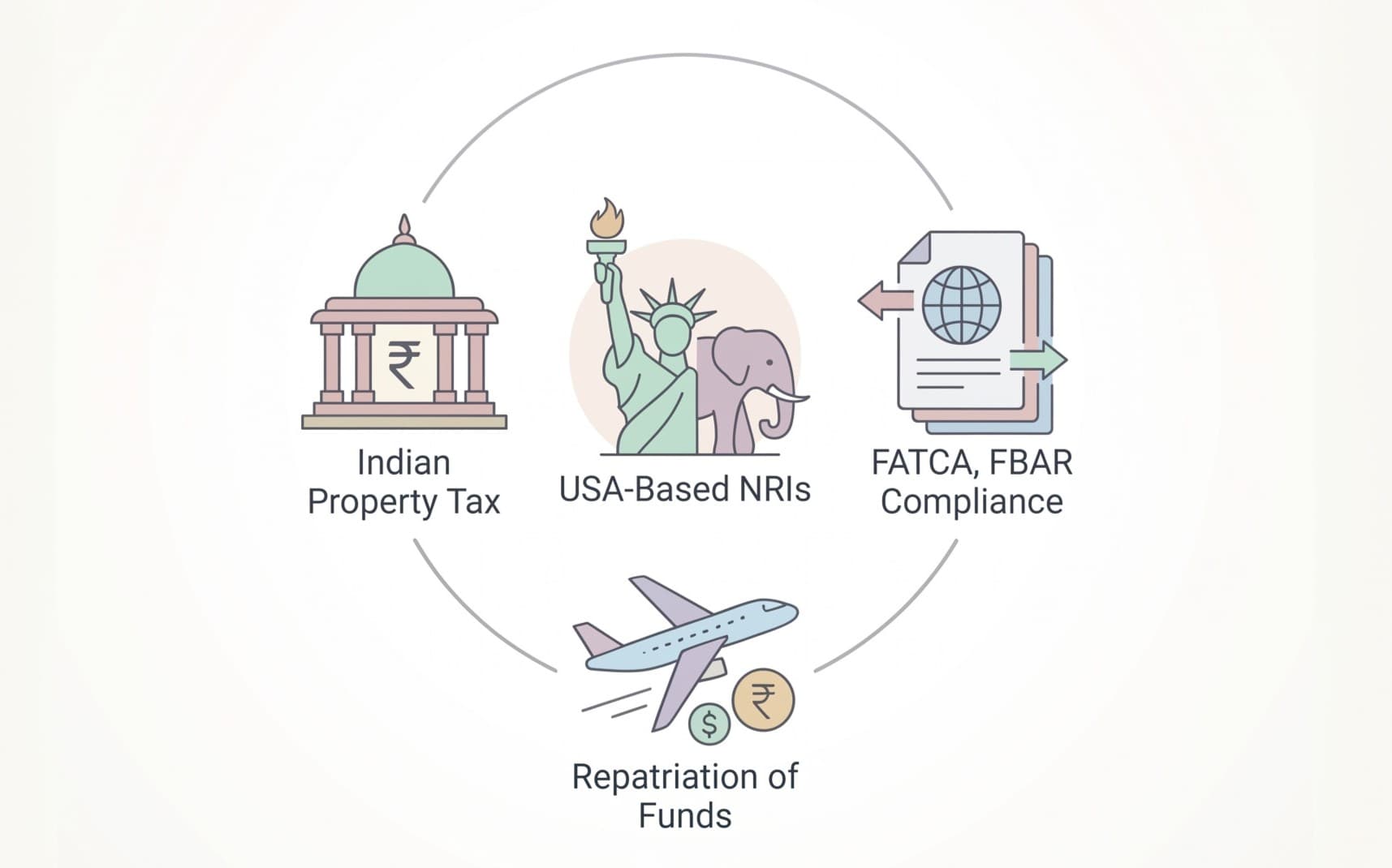
USA has the largest Indian diaspora abroad — approximately 4.5 million people of Indian origin, with about 2.7 million holding Indian-origin status (NRI/OCI/PIO). This community holds the largest aggregate Indian property portfolio of any single country, estimated at USD 75-100 billion across residential, commercial, and inherited assets. The USA-India tax and reporting framework is also the most complex of any country pair.
KEY USA SPECIFICS
Tax Authority: Internal Revenue Service (IRS), Department of Treasury Tax Year: Calendar Year (January 1 to December 31) Filing Deadline: April 15 (with automatic 2-month extension to June 15 for taxpayers abroad; further extension to October 15 with Form 4868) Tax Filing Form: Form 1040 (with relevant schedules) Specific NRI/Foreign Asset Forms: FBAR (FinCEN 114), Form 8938, Form 1116 (foreign tax credit), Schedule E (rental income), Schedule D (capital gains) DTAA: India-USA Double Taxation Avoidance Agreement (1989, with 1991 protocol) DTAA Article for Capital Gains on Property: Article 13 — Capital gains on immovable property are taxable in India (the country where property is located); USA grants foreign tax credit DTAA Article for Rental Income: Article 6 — Income from immovable property taxable in India; USA grants foreign tax credit on Form 1116
USA TAX FILING REQUIREMENTS FOR INDIAN PROPERTY OWNERS
- Worldwide Income Reporting — As US tax resident (citizen, green card holder, or substantial presence test passer), report worldwide income on Form 1040 — including Indian rental income and capital gains.
- Indian Rental Income on Schedule E — Report gross rent in USD (using year-end exchange rate or average rate, applied consistently). Deduct: depreciation (straight-line over 27.5 years for residential; 39 years for commercial), property tax, mortgage interest (Indian home loan interest), repairs, management fees, insurance. Net rental income added to total income, taxed at marginal rate.
- Indian Capital Gains on Schedule D — Sale of Indian property generates capital gain reportable on Schedule D / Form 8949. Long-term capital gain (held over 1 year for US purposes) taxed at 0%, 15%, or 20% depending on income; short-term at ordinary rates. Note: Indian holding period (24 months for long-term) and US holding period (1 year for long-term) differ — calculate both for choice optimisation.
- Foreign Tax Credit on Form 1116 — Indian taxes paid (capital gains tax, TDS on rent, etc.) can be credited against US tax on the same income. Categories — passive (rental income, capital gains), general (most other), separately reported. Excess foreign tax credit can be carried back 1 year or forward 10 years.
- FBAR (FinCEN 114) — Required if aggregate value of all foreign financial accounts exceeded $10,000 at any point in the year. Indian NRO/NRE/FCNR accounts are reportable. File online at FinCEN BSA E-Filing system. Due April 15 with automatic extension to October 15. Penalties: non-willful $10,000 per violation per year (per form); willful $100,000 or 50% of account, whichever greater.
- Form 8938 (Statement of Specified Foreign Financial Assets) — Required if aggregate foreign financial assets exceed thresholds. For unmarried US person living abroad: $200,000 at year end OR $300,000 at any point. For married filing jointly abroad: $400,000 / $600,000. For US-resident filers, lower thresholds. Filed with Form 1040.
- Form 3520/3520-A — If receiving distributions from or owning interest in a foreign trust (HUF may qualify as foreign trust per IRS interpretation in some circumstances). Penalty $10,000+ per year for non-filing.
- Form 5471 — If owning 10%+ in foreign corporation; possibly relevant if Indian property is held through Indian Pvt Ltd entity.
INDIA-US DTAA KEY PROVISIONS
Article 6 (Income from Immovable Property) — Rental income from Indian property taxable in India; US recognises Indian tax through foreign tax credit.
Article 13 (Capital Gains) — Capital gain on sale of Indian immovable property taxable in India; US taxes again but allows foreign tax credit. Credit limited to US tax on the same income (so excess Indian tax cannot reduce US tax on other income; only carried forward).
Article 25 (Non-Discrimination) — NRIs cannot be taxed more heavily than US citizens in similar circumstances.
Article 26 (Mutual Agreement Procedure) — If NRI is double-taxed despite DTAA, can apply to competent authority in either country for relief.
USA-SPECIFIC BANKING AND REPATRIATION NOTES
- Wire transfer from Indian NRO to US bank — standard SWIFT transfer; Indian bank requires Form 15CA/15CB above Rs 5 lakh; US bank may require declaration under Bank Secrecy Act for incoming transfers above $10,000 (automatic CTR filing by bank, not taxpayer obligation).
- FinCEN 105 — Required for cash or monetary instruments above $10,000 carried across US border; typically not applicable to wire transfers.
- FATCA — Indian banks report NRI/NRO account details to Indian Income Tax, which shares with IRS under automatic exchange. USA-based NRIs cannot hide Indian accounts from IRS.
- State tax — some US states (California, New York, New Jersey) tax worldwide income including foreign rental and capital gains; apply foreign tax credit at state level also (varies by state law).
- Social Security — not applicable to Indian property income.
- PFIC rules — typically not applicable to direct Indian real estate; may apply if property held through Indian mutual fund or investment vehicle.
USA NRI COMMON SCENARIOS AND TAX TREATMENT
Scenario 1 — Renting out Mumbai apartment from USA: Indian tax: 30% TDS by tenant, file ITR-2, claim 30% standard deduction + loan interest, pay balance tax / claim refund. US tax: Add net rent to Schedule E (after depreciation), pay marginal rate tax, claim Indian tax as foreign tax credit on Form 1116 (passive category). Net result: Indian + US tax, with credit for Indian tax reducing US tax. Total burden approximately 30-35% of net rental income depending on US state and income level.
Scenario 2 — Selling Bangalore flat held for 5 years: Indian tax: LTCG at 12.5% (post-Budget 2024, without indexation) on gain; TDS by buyer at 12.5% + surcharge + cess; file ITR-2; repatriate via Form 15CA/15CB. US tax: LTCG at 15% or 20% on same gain (1-year US holding period met); claim Indian tax as passive foreign tax credit; typically Indian 12.5-13% credit reduces US 15-20% tax to 2-7% additional. Net result: Combined Indian + US effective tax rate approximately 15-20% of gain.
Scenario 3 — Inheriting Indian property: Indian tax: Inheritance not taxed in India; no Indian capital gains at inheritance. US tax: Inheritance from non-US person — no US estate tax; no Form 3520 obligation for direct inheritance (different from trust distribution). Basis in inherited property — US step-up in basis to fair market value at date of death may apply for US tax purposes, significantly reducing future US capital gains.
USA NRI COMPLIANCE CALENDAR
April 15: FBAR (FinCEN 114) due; Form 1040 due (automatic June 15 extension for overseas residents). June 15: Automatic extension for overseas residents — no filing needed, applies automatically. October 15: FBAR extended due date; Form 1040 extended due date (with Form 4868). July 31: Indian ITR-2 due (Indian financial year April-March). Rolling: Form 15CA/15CB before each repatriation from NRO.
LINKS TO RELEVANT TOPIC BLOGS
- How NRIs can sell Indian property — step-by-step
- Capital gains tax on NRI property sale — LTCG, STCG, Budget 2024
- TDS on NRI property sale — buyer obligations
- Form 15CA & 15CB complete guide
- Repatriation of Indian property sale proceeds
- DTAA mechanics — foreign tax credit for NRI property income
- FATCA & CRS reporting for NRI property owners
- NRO vs NRE vs FCNR — which account for property transactions
For complete details on selling property in India as an NRI and understanding the complete legal, tax, and repatriation process, visit our Selling Property in India page.