
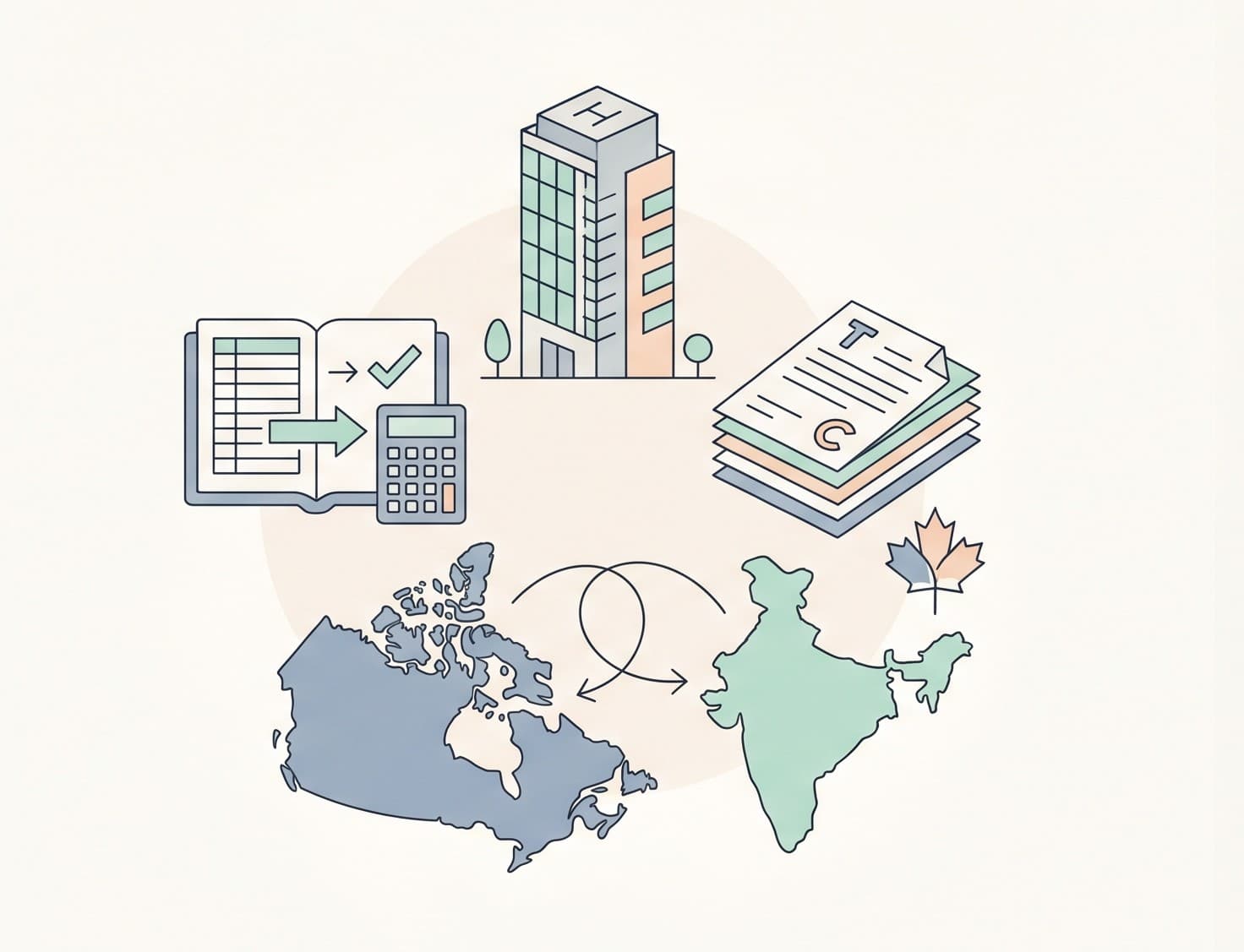
Canada has approximately 1.4 million people of Indian origin, with strong concentrations in Greater Toronto Area, Vancouver, Calgary, and Montreal. Canadian tax residents are taxed on worldwide income, with strict reporting requirements for foreign property. Canada-India tax treaty and CRA's information exchange mechanism create a structured compliance environment.
KEY CANADA SPECIFICS
Tax Authority: Canada Revenue Agency (CRA) Tax Year: Calendar Year Filing Deadline: April 30 (June 15 for self-employed, but tax payment still due April 30) Tax Filing Form: T1 General Specific Forms: T1135 (Foreign Income Verification Statement), T776 (Statement of Real Estate Rentals), T2209 (Federal Foreign Tax Credit), T2036 (Provincial Foreign Tax Credit), Schedule 3 (Capital Gains) DTAA: India-Canada Double Taxation Avoidance Agreement (1996) DTAA Article for Capital Gains: Article 13 — Capital gains on immovable property taxable in India DTAA Article for Rental Income: Article 6 — Income from immovable property taxable in India
CANADA TAX FILING REQUIREMENTS FOR INDIAN PROPERTY OWNERS
- Worldwide Income — Canadian tax residents report worldwide income on T1; Indian rental income and capital gains included.
- Form T1135 (Foreign Income Verification Statement) — Required if total cost of "specified foreign property" exceeded CAD 100,000 at any point in the year. Indian property included (real estate not for personal use, foreign bank accounts, foreign shares). Two reporting tiers: Simplified (CAD 100,000-250,000) — country and broad asset category. Detailed (above CAD 250,000) — each property/account separately disclosed. Penalty for non-filing: CAD 25/day, minimum CAD 100, maximum CAD 2,500; gross negligence penalty 5% of FMV; criminal possible for repeated non-filing.
- Indian Rental Income on T776 — Report gross rent, deduct CCA (Capital Cost Allowance) if claimed, property taxes, mortgage interest, repairs, management. Net included in total income; CCA depreciates building cost over time.
- Indian Capital Gains on Schedule 3 — Disposition of Indian property reported as capital gain. 50% taxable (Canadian inclusion rate); long-term/short-term distinction does not exist in Canada. ACB (Adjusted Cost Base) calculation in CAD using historical exchange rates.
- Foreign Tax Credit on T2209/T2036 — Indian tax paid (capital gains tax, TDS on rent) credited against Canadian tax on same income; federal and provincial separately. Credit limited to Canadian tax on the same foreign income.
- Personal Use Property Exclusion — Indian property held purely for personal use (not rented, not for income generation) is NOT reportable on T1135 — but capital gain on its sale is still reportable on Schedule 3 when sold.
- Departure Tax (when leaving Canada to resume India residence) — Canadian tax residents leaving Canada are deemed to dispose of all capital property at FMV on departure (unrealised gains taxed); election available to defer tax for non-real-property assets.
INDIA-CANADA DTAA KEY PROVISIONS
Article 6 — Rental income from Indian property taxable in India.
Article 13 — Capital gain on Indian immovable property taxable in India; Canada grants foreign tax credit.
Article 24 (Methods of Eliminating Double Taxation) — Canada's method is exemption with progression for some income, credit for others; in practice, foreign tax credit method applies to property income.
Article 26 (Mutual Agreement) — Available for double-tax disputes.
CANADA-INDIA INFORMATION EXCHANGE
Under Canada-India Tax Information Exchange Agreement (TIEA) and CRS, India's tax authority shares Indian bank account data of Canadian tax residents annually. CRA cross-references with T1135 and T1 filings. Banks like HDFC, ICICI Canada (with Canadian operations) facilitate cross-border banking and provide consolidated reports.
REPATRIATION FROM INDIA TO CANADA
- Funds in NRO account post-Indian-tax compliance.
- Form 15CA/15CB filed.
- Indian bank wires CAD or USD (then CAD conversion at Canadian bank) via SWIFT.
- Canadian bank may request source documentation; FINTRAC compliance for amounts above CAD 10,000 (automatic reporting).
- Funds in Canadian account in 1-3 business days.
- Currency exchange rate considerations — INR-CAD has depreciated similarly to USD-CAD historical pattern; Indian large bank wire rate is 1-3% off interbank.
CANADIAN PROVINCIAL CONSIDERATIONS
- Ontario, BC, Alberta, Quebec, Manitoba — Provincial taxes apply on top of federal; foreign tax credit available at both levels (T2209 federal + T2036 provincial).
- Quebec — separate provincial form; Quebec residents file with Revenu Québec separately.
- Provincial residency — based on physical/intentional residence in the province; some Indian-Canadians have moved provinces for tax planning (Ontario to Alberta), affecting overall tax.
COMMON CANADA NRI PROPERTY MISTAKES
- Missing T1135 in early years — discovered later through CRA cross-check; voluntary disclosure through CRA's Voluntary Disclosure Program (VDP) — typically waives penalties if voluntary, complete, and prior to CRA contact.
- Wrong cost basis for ACB calculation — must use FX rate on each transaction date (purchase, improvements); NRIs sometimes use single year-end rate causing material errors.
- Not claiming CCA on Indian rental property — voluntary; once claimed, taxable on disposal (recapture); strategy decision, not automatic.
- Departure tax surprises — Canadians returning to India face deemed disposition of investment portfolio, not Indian real estate (real property exempt from departure tax). Plan asset structure pre-departure.
For complete details on selling property in India as an NRI and understanding the complete legal, tax, and repatriation process, visit our Selling Property in India page.