
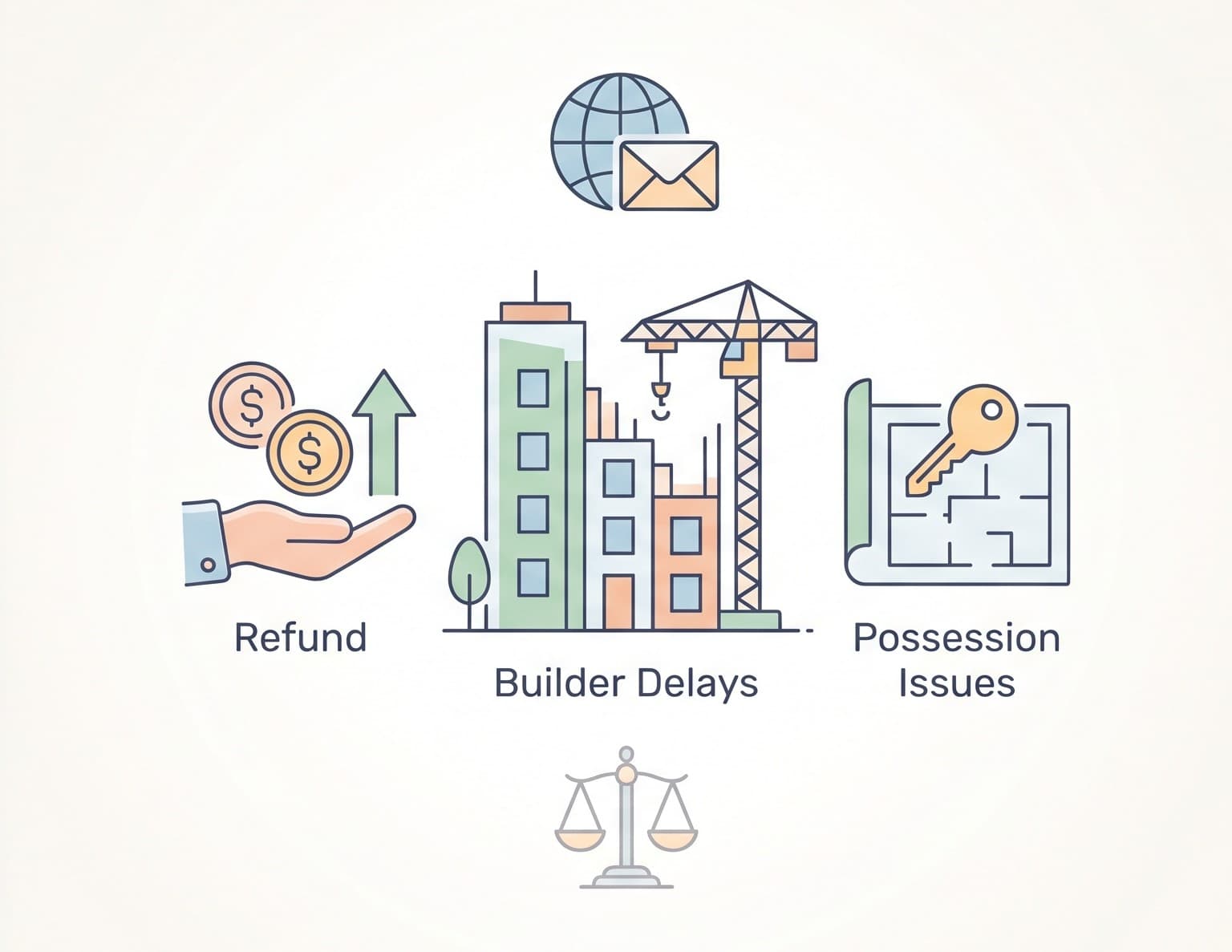
The Real Estate (Regulation and Development) Act 2016 (RERA) has been the single biggest legal protection for Indian property buyers — including NRIs caught in the trap of delayed under-construction projects.
RERA tribunals can be approached entirely from abroad through online filing, video hearings, and POA representation.
This guide explains how NRIs can file and prosecute RERA complaints from any country, with realistic timelines and outcome expectations.
What can an NRI file a RERA complaint for?
RERA grievances against builders/developers cover:
(1) Possession delay beyond agreed date — most common ground; entitles buyer to refund with interest or continuation with interest.
(2) Specifications dilution — promised marble flooring becomes vitrified tiles, modular kitchen becomes basic, branded fittings become generic.
(3) Carpet area discrepancy — actual carpet area less than agreed (RERA mandates carpet area, not super-built-up area).
(4) Hidden charges added at possession — preferential location, club membership, infrastructure charges not mentioned in original agreement.
(5) No Occupancy Certificate at handover — possession given without valid OC, exposing buyer to municipality action.
(6) Refund refusal after withdrawal — buyer wants to withdraw under RERA's permission; builder refuses refund.
(7) Defective construction — leakages, structural issues, defective fittings during 5-year defect liability period.
(8) Common amenities not delivered — promised swimming pool, gym, garden not provided.
(9) Plan deviations — apartment built different from approved plan. (10) Diversion of buyer money to other projects (against RERA's escrow rules).
How does an NRI file a RERA complaint?
RERA filing process from abroad:
(1) Identify the relevant state RERA — based on where the project is located (each state has its own RERA, e.g., MahaRERA, K-RERA, RERA UP, TS RERA, Telangana RERA).
(2) Verify project's RERA registration — the project must be RERA-registered (mandatory for projects above 500 sq m or 8 units). Find the RERA number on the state RERA portal.
(3) Register as complainant on the state RERA portal — submit passport, email, contact details.
(4) File complaint online — fill the complaint form specifying nature of grievance, relief sought (refund, possession, interest, compensation).
(5) Upload supporting documents — buyer-builder agreement, payment receipts, communication trail with builder, RERA registration of project, latest project status.
(6) Pay complaint fee — typically Rs 1,000-5,000 (state-specific). (7) Submit; complaint number assigned.
(8) Hearings scheduled; can be physical or video conferencing depending on state.
(9) NRI attends via video link (most state RERAs accept) or through POA holder/lawyer.
(10) Decision typically within 60-90 days of filing.
What documents does an NRI need for a RERA complaint?
Documentation checklist:
(1) Buyer-Builder Agreement (original or certified copy).
(2) All payment receipts (cheques, RTGS confirmations, FIRC for foreign remittances).
(3) RERA registration certificate of the project (downloadable from RERA portal).
(4) Carpet area declaration in agreement.
(5) Possession date as per agreement and as per any subsequent modifications.
(6) All written communication with builder — emails, WhatsApp, formal letters; demonstrating delay, demand for possession, builder's responses.
(7) Photographs of project (to show construction status).
(8) Brochure or marketing material (to show specifications promised).
(9) Latest construction status from the project's RERA quarterly progress reports.
(10) Power of Attorney if NRI is filing through holder.
(11) NRI's passport, OCI, PAN, address proof.
(12) Calculation of relief sought — refund amount, interest amount, total claim.
What relief can NRI buyer get from RERA?
Relief options under RERA:
(1) Refund of entire amount paid — if buyer chooses to exit; with interest at MCLR + 2% (or repo + 2%, or as per state rules) per annum from each payment date until refund.
(2) Interest on possession delay — if buyer chooses to continue with project; monthly interest at the same rate, payable until actual possession.
(3) Compensation for losses — for instance, rent paid by NRI in alternative accommodation in India during delay period, additional financing costs, loss of rental income.
(4) Specific performance — direction to builder to deliver possession by specified date with penalty.
(5) Penalty on builder — RERA imposes penalty up to 10% of project cost for severe violations.
(6) Attorney fees and complaint costs (in some cases).
(7) For NRI — interest amounts add up substantially over multi-year delays; e.g., Rs 1 crore paid 4 years ago, possession delayed 3 years = approximately Rs 25-30 lakh in interest at 9% rate.
8) Important — RERA's tribunal orders are binding and enforceable; non-compliance attracts contempt and penalties.
How long does a RERA complaint take to resolve?
Realistic timelines:
(1) RERA Act prescribes 60-day disposal of complaints; in practice, complex cases take 90-180 days.
(2) Adjudication phase — initial hearings, builder's response, evidence — 30-90 days.
(3) Order phase — RERA passes order specifying refund, interest, possession date — 60-180 days from filing.
(4) Compliance phase — if builder refuses or fails to comply, recovery action takes another 60-180 days.
(5) Total — 4-12 months for clean cases; longer for complex or contested cases.
(6) Faster jurisdictions — MahaRERA, Telangana RERA, K-RERA tend to dispose cases faster (3-6 months); UP-RERA, RERA Punjab slower (6-12 months).
(7) Appeals — builder can appeal to RERA Appellate Tribunal; adds another 6-12 months.
(8) High Court — appeal beyond Tribunal possible; takes 1-3 more years.
(9) For NRI — first-instance RERA decision typically the most important; willingness to engage in appellate is judgment call.
How are RERA hearings conducted for NRI complainants?
Hearing modalities for NRIs:
(1) Most state RERAs allow video conferencing for NRI complainants (post-COVID, video became standard). MahaRERA, K-RERA, Telangana RERA, UP-RERA, RERA Tamil Nadu commonly use Zoom, Google Meet, or in-house platforms.
(2) NRI attends from abroad — joins video call at scheduled time; may need to verify identity by showing passport on camera.
(3) Through POA holder or advocate — POA can attend physically or via video on NRI's behalf; advocate represents NRI.
(4) Documentary evidence presented through online portal or by counsel during hearing.
(5) Cross-examination — usually limited in RERA proceedings (less formal than civil court); NRI may need to answer factual questions. (6) For complex cases requiring NRI's testimony — physical attendance may be requested or video deposition arranged.
(7) Final order — issued by RERA in writing; sent to NRI's email and made available on portal.
(8) Most NRIs successfully prosecute RERA cases without ever visiting India during the proceeding.
What is the role of RERA Conciliation Forum?
Pre-litigation conciliation under RERA:
(1) Many state RERAs offer conciliation as a preliminary step — voluntary mediation between buyer and builder before formal complaint.
(2) MahaRERA Conciliation Forum is most active — staffed by mediators (usually ex-judges, retired senior officers).
(3) Process — buyer requests conciliation; builder agrees (consent required); session held (often via video for NRIs); mediators help arrive at settlement.
(4) Settlement — if reached, recorded and binding; if not, buyer proceeds to formal complaint.
(5) Faster than litigation — typically 1-2 months.
(6) Builder's incentive to settle — avoids formal RERA order, public disclosure, interest accumulation.
(7) For NRI — useful first step for recoverable claims; preserves flexibility for full litigation if settlement fails.
(8) Statistical outcomes — settlement rates 30-50% in active conciliation forums; many partial settlements (extended timeline + reduced interest) common.
What if the builder doesn't comply with RERA order?
Enforcement actions for non-compliance:
(1) RERA can impose penalty up to 5% of project cost for non-compliance.
(2) Recovery proceedings — RERA can issue recovery certificate to local revenue authority; treated as land revenue arrear; recoverable through attachment of builder's assets, bank accounts.
(3) Project's RERA registration can be cancelled — preventing builder from selling other units or using buyers' funds.
(4) Director's personal liability — RERA can hold company directors personally liable.
(5) Criminal prosecution — under Section 71 for severe violations; imprisonment up to 3 years.
(6) For NRI — execution support from RERA; in practice, recovery from large builders is faster (they have assets, reputation concerns); from small builders or insolvent ones, recovery is harder. (7) Insolvency proceedings — if builder is in insolvency under IBC (Insolvency and Bankruptcy Code), RERA buyers are now treated as financial creditors with secured status; better recovery prospect. (8) Class action possibility — multiple RERA complainants from same project can coordinate for stronger pressure on builder.
For complete details on selling property in India as an NRI and understanding the complete legal, tax, and repatriation process, visit our Selling Property in India page.