
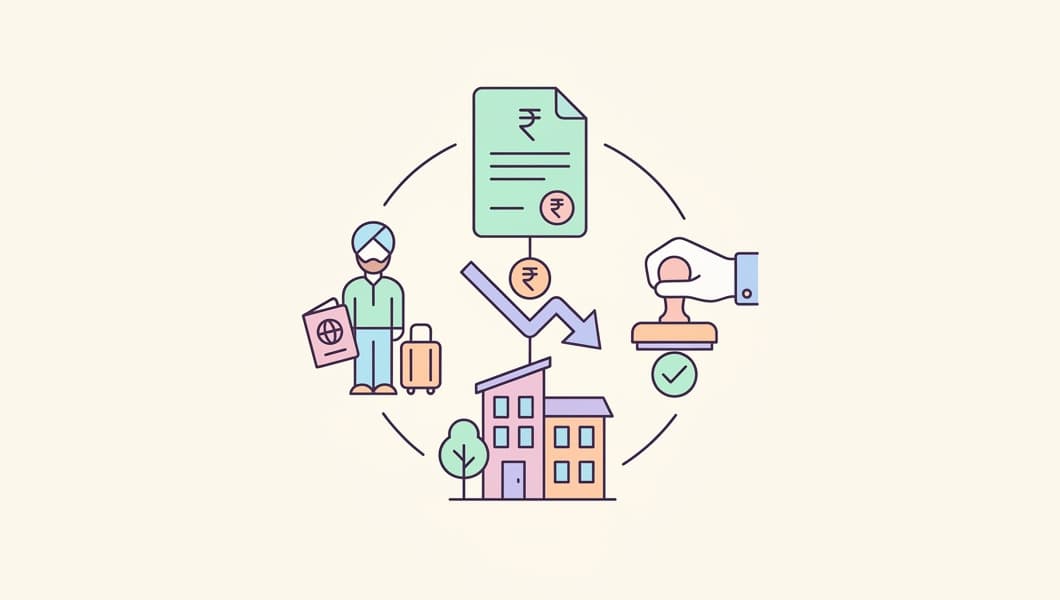
The Lower TDS Certificate (LDC) is the single most important tax compliance document for any NRI selling Indian property — and yet most NRI sellers don't know it exists or apply too late. With an LDC, TDS reduces from the default 12.5-15% on sale price to typically 0.5-3% (matching the actual capital gains tax liability).
On a Rs 2 crore sale, this can mean Rs 25 lakh more in your hand at registration instead of locked up for 6-18 months.
This guide explains exactly how to get one.
What is a Lower TDS Certificate and how does it help an NRI seller?
A Lower TDS Certificate is an order from the Assessing Officer (AO) of the Income Tax Department, issued under Section 197 of the Income Tax Act, permitting the buyer to deduct TDS at a lower rate than the standard rate prescribed under Section 195.
For NRI property sales, the standard TDS rate is 12.5% on sale price (long-term) or 30% (short-term), plus surcharge and cess. With LDC, the TDS rate is reduced to roughly the actual tax liability — typically 0.5-5% of sale value, depending on the capital gain percentage and exemptions claimed. The buyer deducts TDS at the lower rate specified in the certificate. The seller receives a much larger portion of the consideration at closing instead of waiting for refund.
With an example, how much can an NRI save with a Lower TDS Certificate?
Example: Sale value Rs 2 crores; cost basis Rs 1.5 crores (purchased 2018); long-term gain Rs 50 lakhs; expected tax Rs 6.25 lakhs (12.5% of gain) plus surcharge/cess approximately Rs 7.2 lakhs total.
(1) Without LDC — TDS at 12.5% of Rs 2 crore + surcharge + cess = approximately Rs 28-30 lakhs deducted at sale. Excess TDS = Rs 22-23 lakhs locked up, refundable in 6-18 months after ITR filing.
(2) With LDC — TDS at certificate-specified rate (around 3.6% of sale value, equal to actual tax liability) = Rs 7.2 lakhs deducted. Net immediate cash benefit: Rs 22-23 lakhs in hand at sale instead of locked up. Even at modest opportunity cost (8% interest), this is Rs 1.5-3 lakhs of additional value.
How does an NRI apply for a Lower TDS Certificate?
Application process for Form 13 under Section 197:
(1) Apply ONLINE on TRACES portal (NRI must have TRACES login linked to their PAN).
(2) Form 13 is filled with: applicant details, type of payment (sale of property), expected sale value, cost of acquisition, capital gain computation, expected tax liability, requested TDS rate.
(3) Upload supporting documents (see next Q).
(4) Application is forwarded to the Assessing Officer (AO) having jurisdiction over the NRI's PAN.
(5) AO reviews the computation, may ask for additional documents, may call for personal/representative hearing.
(6) If satisfied, AO issues the certificate specifying the lower TDS rate and validity period (typically until the end of the financial year). (7) Certificate is digitally signed and downloadable from TRACES; copy is given to the buyer.
(8) Buyer deducts TDS at the certificate rate; files Form 27Q citing certificate number.
What documents are required for Lower TDS Certificate application?
Documents to upload with Form 13:
(1) PAN, passport, OCI card of the seller.
(2) Sale Deed or Agreement to Sell (if signed) or proof of intent to sell (e.g., listing, valuation).
(3) Cost of acquisition documentation — original Sale Deed when bought, payment receipts, bank statements showing funds, capital improvements receipts.
(4) For inherited property — will, succession certificate, mutation, original cost paid by previous owner.
(5) Transfer expenses estimate — broker commission, legal fees, Form 13 professional fees.
(6) Tax computation in prescribed format — capital gain (long-term/short-term), tax thereon (12.5% LTCG or applicable), surcharge, cess, total.
(7) Section 54/54EC/54F exemption claim if planning to reinvest — with declaration.
(8) Bank account details for refund (if any).
(9) Authorisation letter / POA if filing through representative or CA. Engage a CA or tax practitioner experienced in Form 13 — first-time DIY applications often face queries and delays.
How long does it take to get a Lower TDS Certificate?
Processing timelines vary significantly by jurisdiction:
(1) Officially — within 30 days of complete application (no queries pending).
(2) Practically — 4-12 weeks depending on AO workload, jurisdiction, and case complexity. International Tax (NRI) AOs in major cities (Delhi, Mumbai, Bangalore, Chennai, Hyderabad) handle high volumes — Mumbai and Delhi tend to be slower (8-16 weeks); Bangalore and Hyderabad faster (4-8 weeks).
(3) Reasons for delay: incomplete cost basis documentation, valuation queries, exemption claim verification, AO transfers, hearing scheduling.
(4) For NRIs planning to sell, Form 13 application should be the FIRST step — apply 8-16 weeks before planned registration date. (5) For urgent sales, some sellers complete the registration first and obtain a refund through ITR — costs in lockup but avoids closing delay.
Which Assessing Officer has jurisdiction for an NRI's Form 13?
Jurisdiction is based on the NRI's PAN:
(1) NRIs have PAN registered with International Tax / Foreign Section AO in the city where the NRI's last Indian address was, OR where the NRI's primary Indian property is located.
(2) Major International Tax circles: Delhi (DIT International Tax), Mumbai (DIT International Tax & Transfer Pricing), Bangalore (DIT IT-TP), Chennai (DIT IT), Hyderabad, Pune, Ahmedabad, Kolkata. (3) Check your jurisdictional AO using "Know Your Jurisdictional AO" service on Income Tax e-filing portal.
(4) If the property is in a different city than your PAN jurisdiction, you may apply to the AO where the property is located OR where your PAN is — practical choice depends on response time.
(5) AO transfer requests are possible but slow — better to start with whichever jurisdiction is more responsive.
Can an NRI apply for Lower TDS Certificate after the sale is done?
Technically YES, practically NOT useful. Form 13 can be applied at any time — but it can only reduce TDS for FUTURE deductions. Once the buyer has already deducted at standard rate and deposited, that excess TDS can only be refunded through ITR.
The window:
(1) Best practice — apply 8-16 weeks BEFORE registration, get LDC, share with buyer before deduction.
(2) If sale is imminent and LDC not yet received — request the buyer to delay payment timing if possible (e.g., split payment so first tranche has minimal TDS, second tranche after LDC).
(3) If sale is done with full TDS deducted — file ITR claiming refund; LDC application is now moot.
(4) Special case: under-construction property where multiple instalments are due — apply for LDC for FUTURE instalments even if past instalments saw full TDS.
What are the most common reasons Lower TDS Certificate applications get rejected?
Common reasons for rejection or modification of LDC:
(1) Inadequate cost basis documentation — AO disputes the claimed cost, leading to higher computed gain and higher TDS rate. (2) Aggressive Section 54/54EC/54F claims — AO not satisfied with the reinvestment intent or eligibility; reduces or rejects exemption. (3) Indexation choice — AO may dispute the year of acquisition or CII used.
(4) Pending tax dues — AO may refuse LDC if applicant has pending tax demand or non-filing of past ITRs.
(5) Mismatch with Form 26AS — past ITR data inconsistencies trigger queries.
(6) Inadequate Section 56(2) treatment — if sale price is below circle rate and the gap is not properly addressed.
Mitigation: file ITRs of past 3-5 years before applying, organise cost basis documents thoroughly, get a professional tax practitioner to draft the application.
For complete details on selling property in India as an NRI and understanding the complete legal, tax, and repatriation process, visit our Selling Property in India page.