
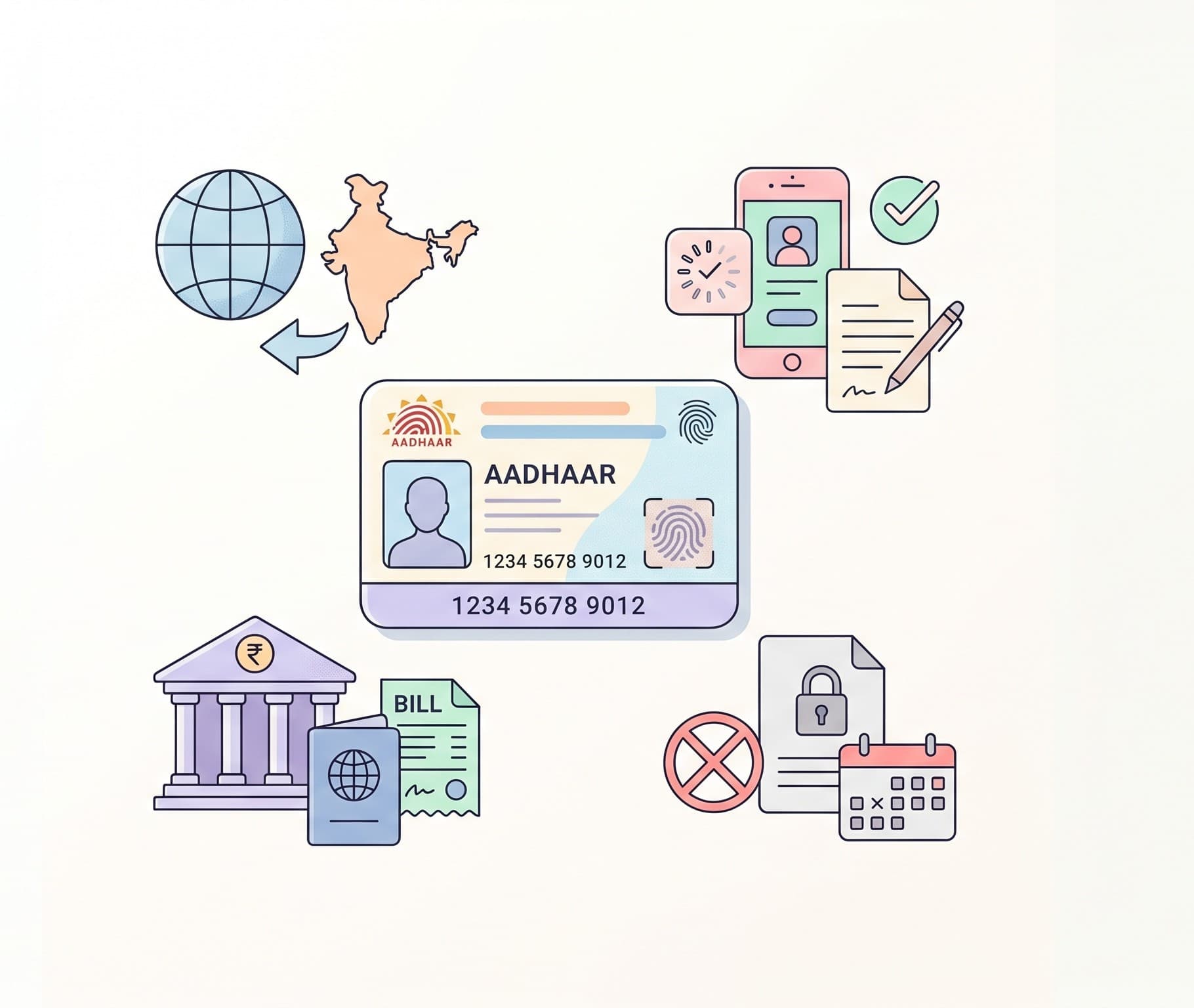
Aadhaar — the 12-digit unique identifier issued by UIDAI — is increasingly the gateway to most Indian services. NRIs occupy a complex position: not all NRIs are eligible to enrol, and not all government services that require Aadhaar are equally accessible to NRIs.
For property transactions, Aadhaar is convenient but not strictly mandatory for NRIs — PAN is the primary identifier. This guide explains Aadhaar's relevance for NRI property holders.
Are NRIs eligible to apply for Aadhaar?
Aadhaar eligibility framework:
(1) Aadhaar Act 2016 defines an "Indian resident" as a person who has resided in India for 182 days or more in the 12 months immediately preceding the date of application.
(2) NRIs (most of whom spend less than 182 days/year in India) are typically NOT eligible.
(3) Exception 1 — NRIs holding Indian passport who have resided in India for 182+ days in the preceding 12 months can apply.
(4) Exception 2 — NRIs returning to India for permanent settlement can apply once they meet the 182-day threshold.
(5) Per recent updates — NRIs holding Indian passports can now enrol for Aadhaar without the 182-day residence requirement (per UIDAI direction). Available at specific Aadhaar centres in major metros.
(6) OCIs and foreign citizens — generally NOT eligible for Aadhaar; OCI does not equal Indian citizenship.
(7) For NRIs with old Aadhaar — issued during periods of Indian residency; remains valid but updates may need physical visit.
How does an NRI apply for Aadhaar?
Application process for eligible NRIs:
(1) Visit an Aadhaar Seva Kendra (in major Indian cities — list available at uidai.gov.in).
(2) Carry — Indian passport (proof of identity and citizenship), proof of address (NRO/NRE bank statement, Indian property tax receipt, voter ID, utility bill), and supporting documents demonstrating eligibility.
(3) For NRIs without 182 days — bring additional documentation: Indian property ownership proof, self-declaration; new UIDAI rules allow Aadhaar for Indian-passport-holding NRIs without strict residency requirement at designated centres.
(4) Biometric enrolment — fingerprints, iris scan, photograph captured at the centre. Mandatory in person.
(5) Acknowledgement slip with Enrolment ID issued.
(6) Aadhaar generated — typically 15-30 days; can check status at UIDAI portal.
(7) Aadhaar physical card (e-Aadhaar PDF) downloadable; physical printed card by post.
Where can NRIs enrol for Aadhaar within India and abroad?
Aadhaar enrolment locations:
(1) Aadhaar Seva Kendras — UIDAI-operated permanent centres in major cities (Delhi, Mumbai, Bangalore, Chennai, Kolkata, Hyderabad, Pune, Ahmedabad, Lucknow, Patna, Bhopal, etc.). NRI-friendly counters available in some.
(2) Bank branches — many SBI, ICICI, HDFC branches host Aadhaar centres; appointment-based.
(3) Post offices — some post offices have Aadhaar enrolment kiosks.
(4) Some Indian Embassies/Consulates abroad — pilot-stage initiative; available in select countries (UAE, Singapore, etc.) at certain consulates; limited capacity and appointment-only.
(5) For NRIs in major countries — check Indian Consulate website for Aadhaar service availability; if not available, must visit India.
(6) Mobile apps — mAadhaar app for downloading e-Aadhaar, requesting OTP services; not a substitute for enrolment.
(7) Online enrolment — only for updates to existing Aadhaar; new enrolment requires physical biometric capture.
When is Aadhaar mandatory for NRI property transactions?
Aadhaar's role in NRI property — generally NOT mandatory:
(1) PAN is primary identifier — sufficient for most NRI property transactions.
(2) Property registration — sub-registrars accept passport for NRIs; Aadhaar is one of acceptable IDs but not required if PAN and passport provided.
(3) NRO/NRE account opening — passport, PAN, OCI sufficient; Aadhaar optional.
(4) ITR filing — NRIs can file ITR-2 without Aadhaar (PAN-Aadhaar linking exempt for NRIs).
(5) Property tax payment — most cities accept payment without Aadhaar; some municipal apps prefer Aadhaar but allow alternatives.
(6) DBT, government subsidies — not relevant to most NRIs.
(7) Bank loans — Aadhaar accepted but not mandatory; passport-based KYC accepted.
(8) For specific situations — Aadhaar may speed up certain processes (e.g., e-signing using Aadhaar OTP for certain documents).
(9) Bottom line — NRIs without Aadhaar are not at significant disadvantage; PAN + passport works for almost all property scenarios.
What are the use cases where Aadhaar is helpful for NRI property?
Aadhaar advantages for NRI property holders:
(1) E-KYC — instant verification at banks, mutual funds, brokerages reduces paper KYC time.
(2) Aadhaar-based digital signature — for ITR, certain affidavits, e-stamping in some states.
(3) Property tax portal access — some city portals (Bangalore BBMP, Hyderabad GHMC) integrate with Aadhaar for faster property linking.
(4) DigiLocker — store digital copies of property documents, link to Aadhaar; access from anywhere.
(5) Aadhaar-based authentication for sub-registrar — biometric at registration faster than alternative ID verification.
(6) Aadhaar-linked tenant verification — landlords can verify tenant Aadhaar through portals.
(7) Long-term — government services increasingly Aadhaar-first; future property-related digital initiatives may require Aadhaar.
(8) For NRIs returning to India permanently — Aadhaar enables faster integration into Indian financial system.
(9) For Aadhaar-eligible NRIs who can spare a India visit, getting Aadhaar is a low-cost-high-utility step.
What are the privacy and security concerns with Aadhaar for NRIs?
Aadhaar privacy considerations:
(1) Aadhaar number is sensitive — should not be shared widely; lock biometric authentication if not in active use.
(2) Authentication leak risks — Aadhaar number + name has been exposed in various data breaches; not preferred as primary identifier where alternatives exist.
(3) UIDAI security measures — masked Aadhaar (last 4 digits visible only), Virtual ID (16-digit temporary number for authentication), biometric lock/unlock.
(4) For NRIs — using Aadhaar for property transactions exposes the number in registration records (publicly accessible registries in some states).
(5) Best practice — use masked Aadhaar where possible, generate Virtual ID for authentication, lock biometrics when not in active use, monitor authentication attempts (UIDAI sends SMS for each authentication).
(6) For NRIs in countries with strict data protection (USA, EU GDPR) — Aadhaar in foreign databases is legally complex; Indian banks under FATCA/CRS share Aadhaar to foreign tax authorities.
(7) Consider whether Aadhaar's marginal benefit is worth the privacy footprint — for many NRIs, PAN-only path is sufficient.
Can an NRI Aadhaar be used for digital signatures?
Aadhaar e-signing applications:
(1) Aadhaar e-Sign — legally recognised digital signature; uses Aadhaar OTP for authentication.
(2) Use cases — ITR e-verification, certain government forms, some bank documents, digital agreements on platforms supporting Aadhaar-based e-Sign (e.g., NSDL, eMudhra, signNow).
(3) For property — limited acceptance currently; sub-registrar registration requires biometric in person; Aadhaar e-Sign not yet fully integrated with property registration.
(4) For agreements — e-stamping (in states like Maharashtra, Karnataka) may integrate with Aadhaar for faster execution. (5) Limitation — Aadhaar e-Sign requires linked mobile number for OTP; if NRI's linked mobile is Indian and they're abroad, OTP delivery may fail; update mobile on Aadhaar to receive on international number (currently limited support).
(6) Alternatives — Class 2/3 Digital Signature Certificate (DSC) issued by certifying authorities (eMudhra, Sify, NIC); valid for ITR, tendering, certain registrations; works without Aadhaar.
What are the limitations of Aadhaar for NRIs and what to know?
Practical limitations:
(1) Eligibility — not available to OCIs and foreign citizens; some NRIs cannot get Aadhaar even if they want to.
(2) Updates require physical presence — biometric updates need in-person visit to Aadhaar centre; NRIs must wait for India trip.
(3) Mobile linkage — Aadhaar linked mobile typically Indian; if NRI's Indian SIM is inactive, OTPs can't be received; update mobile on UIDAI portal (requires authenticated update).
(4) Mandatory for certain services — some Indian government services (LPG subsidy, certain pensions) made Aadhaar-mandatory; NRIs without Aadhaar may need alternative paths.
(5) Address mismatch — Aadhaar address (Indian) vs current residence (overseas); creates discrepancies in some KYC processes; document explanatory affidavit.
(6) For OCI cardholders — separate UCN (Unique Citizen Number) under OCI but no Aadhaar equivalent; OCI card serves as primary ID for OCI-eligible services.
|(7) Future evolution — UIDAI expanding NRI access; track changes through Indian Embassy advisories.
For complete details on selling property in India as an NRI and understanding the complete legal, tax, and repatriation process, visit our Selling Property in India page.