
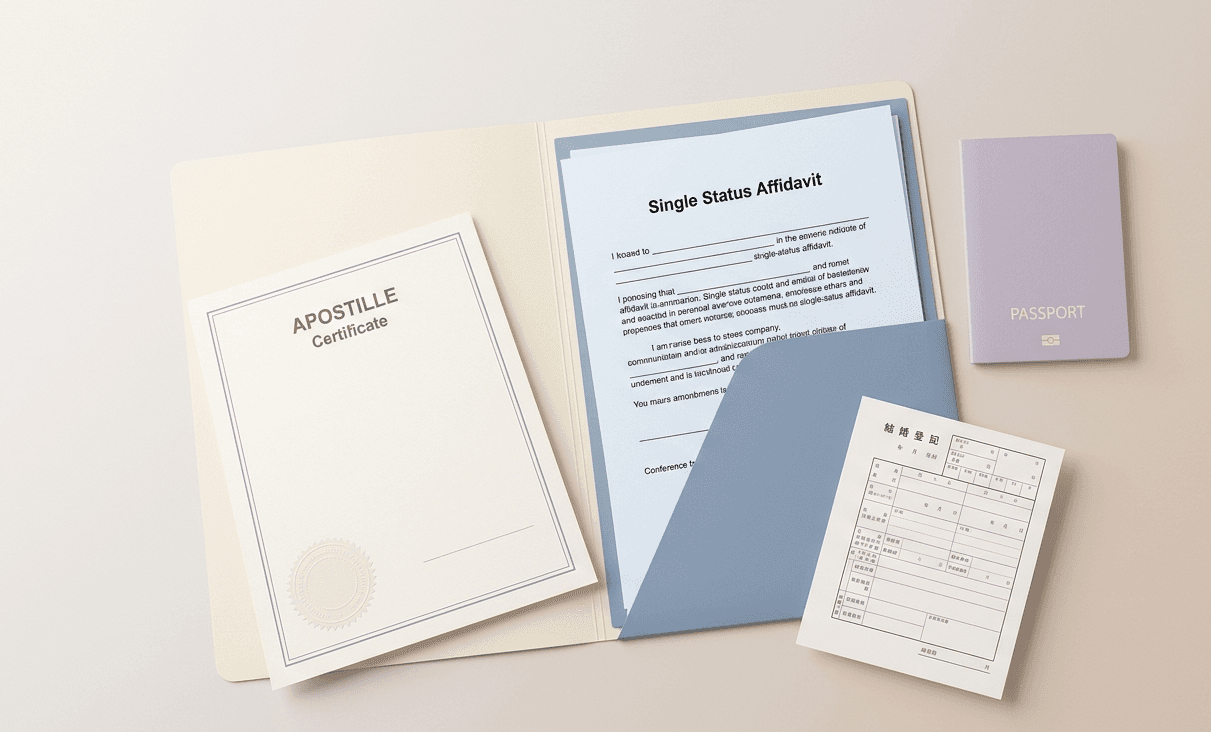
Marrying in Japan as an Indian national or NRI involves one document that surprises almost everyone the first time they hear about it: proof that you're actually free to marry. It doesn't come from a government office the way a birth certificate does, and there's no single form to fill out and collect. It's called a Bachelorhood Certificate, or more commonly a Single Status Certificate, and getting it wrong — or leaving it too late — is one of the most common reasons NRI couples find their Japanese marriage registration delayed.
Here's exactly what this document is, why Japan specifically requires it, and how to get it done properly from wherever you're currently living.
What a Bachelorhood Certificate Actually Is
This is the detail that trips people up first: India doesn't have a government authority that issues an "unmarried certificate" the way it issues a passport or a PAN card. What gets called a Bachelorhood Certificate — also known as a Single Status Certificate, No Impediment Certificate, Celibacy Certificate, or Marriageability Certificate depending on which agency or country you're dealing with — is actually a sworn affidavit. You, the applicant, declare in writing that you are currently unmarried and legally free to marry, sign it before a notary, and then that declaration gets formally authenticated through a chain of Indian government attestations until it's recognized as valid for use in Japan.
It's worth internalizing this distinction early, because it changes how you approach the whole process. You're not waiting on a government office to issue you something — you're creating a legal document yourself, correctly, and then getting the right authorities to certify that it's genuine.
Why Japan Specifically Requires an Apostilled Version
Japan is a member of the Hague Apostille Convention, which is the detail that determines the entire authentication pathway. Because both India and Japan are Convention members, a Single Status Affidavit only needs to be apostilled by India's Ministry of External Affairs — it does not require additional legalization or attestation by the Japanese Embassy or Consulate afterward. A local Indian notary stamp alone, without the MEA apostille, is not sufficient and will not be accepted by Japanese municipal marriage registrars, since a plain notarized statement carries no international certification of its authenticity.
This matters practically because it tells you exactly where the process ends: once your affidavit carries a valid MEA apostille stamp, it's ready to submit to the Japanese municipal office handling your marriage registration (Konin Todoke), without a separate embassy visit in Japan.
The Step-by-Step Process to Obtain and Authenticate the Affidavit
Drafting the affidavit. The document needs to clearly state your full name, date of birth, nationality, current marital status (never married, divorced, or widowed), and an affirmative statement that you are legally free to marry. This is typically prepared on non-judicial stamp paper and should closely match the wording formats Indian attestation authorities are used to processing — deviating significantly from standard formats is a common cause of rejection or delay at the state attestation stage.
Notarization. The affidavit is signed before a Notary Public in India, formally converting your personal declaration into a notarized legal document.
State-level attestation. Before the MEA will apostille the document, it typically needs attestation from the relevant state authority — commonly the Home Department, General Administration Department, or a Sub-Divisional Magistrate, depending on which state issued or is processing the affidavit. This step is where a meaningful share of delays happen, since state-level processing times vary and some states move considerably faster than others.
MEA apostille. The final step is apostille certification from India's Ministry of External Affairs, which confirms the authenticity of the state-level attestation. This is the certification that makes the document valid for use in Japan under the Hague Convention framework, and it's the step that completes the chain — no further legalization by any Japanese authority is required after this.
Realistically, the full chain — notarization through state attestation to MEA apostille — commonly takes somewhere in the range of two to four weeks depending on which state is processing your attestation and how promptly each stage is completed, though some jurisdictions offer faster alternative routes that can compress this considerably.
The NRI-Specific Challenge: Doing This From Outside India
For an NRI who isn't currently in India, this entire chain presents an obvious practical problem: several of these steps traditionally assumed physical presence. Two practical workarounds handle this in practice. The first is executing a Power of Attorney in favor of a trusted representative — often a parent or sibling — in India, authorizing them to draft, notarize, and carry the affidavit through the state attestation and MEA apostille process on your behalf. The second, relevant specifically to the affidavit drafting and initial notarization stage, involves the Indian Embassy or Consulate in your country of residence, which can notarize certain supporting declarations, though it's worth being clear that the underlying certificate itself still needs to be processed and apostilled through the Indian chain described above — an embassy abroad cannot independently issue or apostille the document itself.
Given this, most NRIs planning a Japan wedding find it considerably smoother to start this process weeks, not days, before they need it, and to coordinate closely with whoever is executing the in-India steps on their behalf.
What Else Japanese Municipal Offices Typically Ask For
The Single Status Affidavit rarely travels alone. Japanese municipal offices processing a Konin Todoke (marriage registration) for a foreign national typically also expect a certified Japanese translation of the affidavit, since documents submitted to Japanese civil registries generally need to be in Japanese regardless of the original language. Alongside this, expect to provide your passport, and depending on the specific municipal office, potentially a birth certificate. If either party is under a certain age or the municipal office's own procedures require it, a parental declaration may also be requested — this varies enough by local ward office that it's worth confirming directly with the specific municipal office handling your registration rather than assuming a uniform national requirement.
Special Cases: Divorced or Widowed Applicants
If you've been previously married, the single status affidavit alone isn't sufficient — you'll need to additionally provide an apostilled copy of your divorce decree if divorced, or an apostilled death certificate of your former spouse if widowed, alongside the affidavit itself. These supporting documents go through the same notarization, state attestation, and MEA apostille chain, and it's worth having them ready and apostilled at the same time as the main affidavit rather than treating them as an afterthought, since a mismatch in timing between documents is a common cause of the whole submission being sent back for correction.
Timeline and Validity: Why Timing Relative to Your Wedding Date Matters
While an MEA apostille itself doesn't technically expire, Japanese municipal offices — like most foreign marriage registrars — generally expect the underlying affidavit to have been issued within a recent window, commonly the past three to six months. This means starting the process too far ahead of your actual wedding date can backfire just as badly as starting too late; if your registration date slips and the certificate ages past what the municipal office considers current, you may need to redo part of the process. Coordinating the affidavit's issuance date against your realistic registration timeline, with some buffer for Japan-side scheduling, is worth planning deliberately rather than treating as an afterthought.
Common Mistakes NRIs Make With This Process
The most frequent misunderstanding is assuming the Indian Embassy or Consulate abroad can simply issue the certificate directly — it can't; the underlying document must originate and be attested within India's own chain. A second common mistake is submitting the affidavit for MEA apostille before completing the required state-level attestation, which results in rejection and lost time. A third is underestimating the Japanese translation requirement, assuming the apostilled English or Hindi document will be accepted as-is by the municipal office. And a fourth, particularly relevant for NRIs juggling this from a different time zone, is leaving the entire process until a few weeks before the planned registration date, without accounting for the two-to-four-week attestation chain plus translation and courier time on top of it.
Frequently Asked Questions
1. Can the Indian Embassy in Japan issue a Bachelorhood Certificate directly?
No. The certificate must originate in India through notarization, state attestation, and MEA apostille. Embassies abroad can assist with certain notarial functions but cannot issue or apostille the certificate itself.
2. Does Japan require embassy legalisation in addition to the MEA apostille?
No. Since both India and Japan are Hague Apostille Convention members, an MEA apostille alone is sufficient — no further Japanese embassy legalisation is required.
3. Can an NRI complete this process without travelling to India?
Yes, typically through a Power of Attorney authorising a representative in India to handle notarization, state attestation, and the MEA apostille on the applicant's behalf.
4. How long is a Single Status Certificate considered valid for a Japan marriage registration?
While the apostille itself doesn't expire, most Japanese municipal offices expect the underlying certificate to have been issued within the past three to six months, so timing it against your actual registration date matters.