
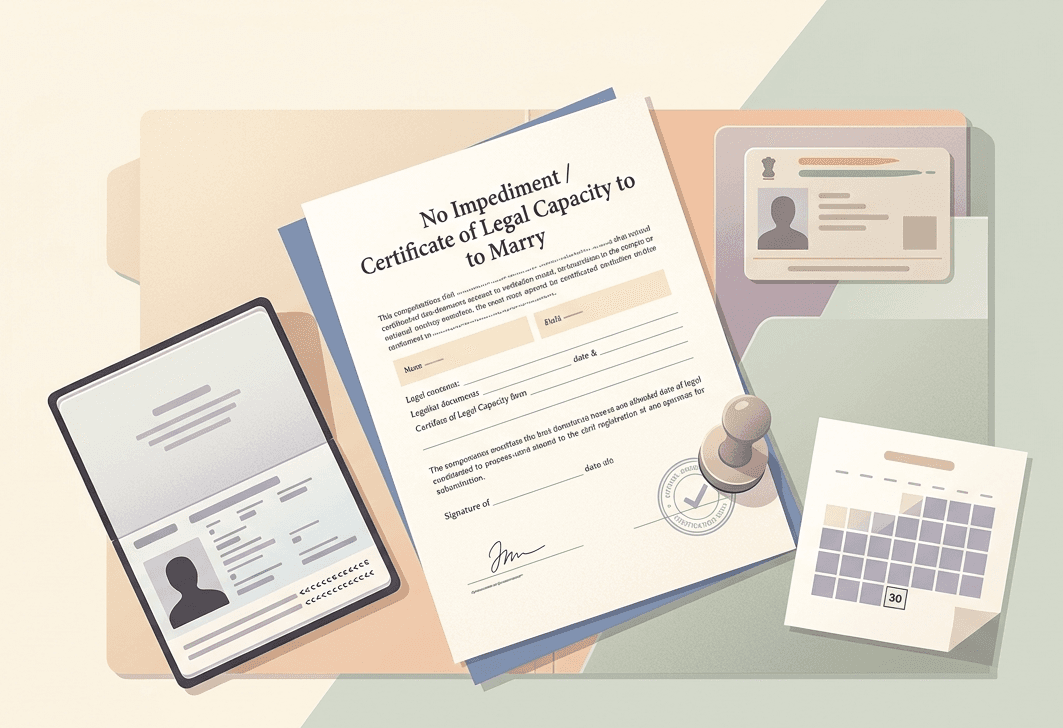
When an Indian citizen and a foreign national decide to marry in India, the Special Marriage Act, 1954, is almost always the route they end up using. It's the law built precisely for this situation — a civil marriage that doesn't depend on either partner's religion. But couples going through it quickly run into a document request that trips up more people than it should: proof that the foreign partner is legally free to marry, commonly called a No Impediment Certificate or No Objection Certificate. The question that follows almost immediately is whether this is actually a legal requirement, or something Marriage Officers ask for out of habit.
This guide walks through what the Special Marriage Act itself says, what Marriage Officers actually expect in practice, and how foreign partners can prepare for this part of the process without unnecessary delays.
What the Special Marriage Act Actually Requires
The Special Marriage Act, 1954, provides a secular civil marriage framework available to any two people in India, regardless of religion, and extends to marriages involving a foreign national and an Indian citizen. Under the Act, both parties must meet a basic set of conditions: neither can already be married, both must be of sound mind capable of giving valid consent, both must meet the minimum age requirement, and the couple must not fall within a prohibited degree of relationship.
Here's the detail that surprises a lot of couples: the Act itself doesn't explicitly mandate a formal "No Impediment Certificate" from a foreign embassy. What it requires is that both parties genuinely satisfy these eligibility conditions — the certificate is simply the evidence Marriage Officers commonly rely on to confirm that the foreign partner meets them.
Why Marriage Officers Ask for It Anyway
Even though the statute doesn't spell out an embassy document as a hard requirement, in practice, most Marriage Officers request some form of proof from the foreign partner's home country or its diplomatic mission confirming single status and legal eligibility to marry. This isn't arbitrary — Indian civil registrars have no independent way to verify a foreign national's marital history, and the certificate fills that verification gap the same way it would in reverse, if an Indian citizen were marrying abroad.
This document goes by a few interchangeable names depending on which embassy issues it or which lawyer is drafting the checklist: No Impediment Certificate, No Objection Certificate (NOC), Single Status Certificate, or Certificate of Legal Capacity to Marry. Whatever the label, the underlying purpose is the same — confirming there's no legal obstacle preventing the marriage under the foreign partner's home country law.
Where the Foreign Partner Obtains This Document
For most foreign nationals, the certificate is obtained from their own country's embassy or consulate located in India, though procedures vary meaningfully by nationality. Some embassies issue a formal letter directly; others expect the applicant to first secure a certificate from their home civil authority and bring it to the embassy in India for endorsement.
This is also where couples run into the most friction. Not every country maintains a straightforward process for issuing this kind of certificate, and some — including notably the United States — have no centralised government body that certifies single status at all, since marital records in the US are maintained at the state or county level rather than nationally.
When the Foreign Partner's Country Doesn't Issue This Certificate
This gap matters more than it might seem. If the foreign partner's home country doesn't issue an official single-status document, or their embassy in India declines to provide one, Indian Marriage Officers generally do accept alternative evidence, since the Act's underlying requirement is proof of eligibility, not one specific document format.
Commonly accepted alternatives include:
-
A sworn affidavit made by the foreign national declaring their nationality, current marital status, and legal freedom to marry, notarised in India or in their home country
-
A certified copy of the foreign national's passport confirming nationality and current validity
-
Where applicable, a court-certified copy of relevant civil records from the home country obtained through legal channels
-
Additional identity verification, sometimes involving the local Foreigners Regional Registration Office (FRRO) or local police, particularly when an embassy is unable or unwilling to issue a formal letter
Since acceptance of these alternatives varies by Marriage Officer and jurisdiction, it's worth confirming directly with the specific district Marriage Office handling the application rather than assuming a uniform national policy.
The Standard Document Checklist for SMA Marriages Involving a Foreign National
Beyond the no-impediment documentation itself, couples marrying under the Special Marriage Act with one foreign partner should generally be prepared with:
-
Valid passports and visas for both parties
-
Birth certificates, apostilled or attested where the foreign partner's document originates outside India
-
Proof of residence for at least thirty days in the district where the Notice of Intended Marriage is filed
-
Divorce decree or death certificate of a former spouse, apostilled or attested, if either party was previously married
-
An affidavit of intention to marry, confirming the decision is voluntary and free of coercion
-
Passport-sized photographs
-
Certified English translations of any document not already in English
Step-by-Step: The Special Marriage Act Process
-
Determine jurisdiction. File the Notice of Intended Marriage with the Marriage Officer of the district where either party has resided for at least thirty days immediately prior.
-
Submit the notice and supporting documents. This includes the no-impediment documentation, identity proof, and residence evidence for both parties.
-
Publication of the notice. The Marriage Officer publishes the notice, opening a thirty-day period during which objections to the marriage can be raised.
-
Resolution of any objections. If an objection is filed, the Marriage Officer reviews it before proceeding; if none arise, the process continues unimpeded.
-
Solemnisation of the marriage. After the waiting period concludes, the marriage is solemnised at the Marriage Office, with both parties and witnesses present.
-
Issuance of the marriage certificate. Once solemnised, the Marriage Officer issues the official certificate recognised under Indian law.
What Happens If the Foreign Partner's Embassy Refuses to Issue an NOC
This scenario comes up more often than couples expect, sometimes because of family objections back home, sometimes simply because the embassy's internal policy doesn't extend to issuing this kind of letter. When this happens, the practical path forward usually involves leaning more heavily on the alternative documentation described earlier — a notarised affidavit combined with passport verification and, where possible, a certified extract from the home country's civil records obtained independently rather than through the embassy.
Since Marriage Officers have some discretion here, couples facing this situation often benefit from consulting a lawyer experienced in Special Marriage Act filings, particularly to help frame the affidavit and supporting evidence in a way the specific Marriage Office is likely to accept.
Common Mistakes Couples Make
-
Assuming the certificate is a rigid legal mandate. The Act requires proof of eligibility, not one specific certificate — understanding this distinction opens up alternatives when the standard document isn't available.
-
Not confirming the local Marriage Office's specific expectations early. Requirements can differ between districts, so a document accepted in one city's Marriage Office may face pushback in another.
-
Underestimating the thirty-day residency requirement. This applies before the notice can even be filed, and foreign partners sometimes miscalculate their eligible filing date.
-
Skipping translation or attestation on foreign documents. Any document not in English typically needs certified translation, and this step is often left until too late.
Final Thoughts
The no-impediment requirement under the Special Marriage Act sits in an area many couples assume is more rigid than it actually is. The law asks for proof that the foreign partner is genuinely free to marry — it doesn't lock couples into a single certificate format, particularly when a home country's bureaucracy simply doesn't produce one. Understanding this distinction, confirming expectations with the specific Marriage Office involved, and preparing solid alternative documentation where needed tends to make the difference between a smooth thirty-day process and one that stalls over a document that was never strictly mandatory in the first place.
Frequently Asked Questions
1. Is the No Impediment Certificate legally mandatory under the Special Marriage Act?
Not explicitly. The Act requires proof that both parties are legally free to marry, but it doesn't name a single mandatory certificate. In practice, most Marriage Officers request one because it's the most straightforward evidence available, but alternatives exist when it can't be obtained.
2. How long does the embassy documentation process typically take?
This varies widely by nationality and embassy workload, but couples should generally budget several weeks, particularly if the foreign partner's home country requires them to first obtain a certificate domestically before the embassy in India will endorse or countersign it.
3. Can the marriage proceed if the embassy simply doesn't respond?
Marriage Officers generally won't wait indefinitely for an unresponsive embassy. In these cases, shifting toward the affidavit-and-passport-verification alternative, ideally with legal guidance, tends to be the more realistic path forward.
4. Does the thirty-day objection period apply differently to foreign nationals?
No — the same publication and objection window applies regardless of either party's nationality. What differs is often the residency proof, since a foreign partner may need visa or FRRO documentation to establish the required thirty-day residence.