
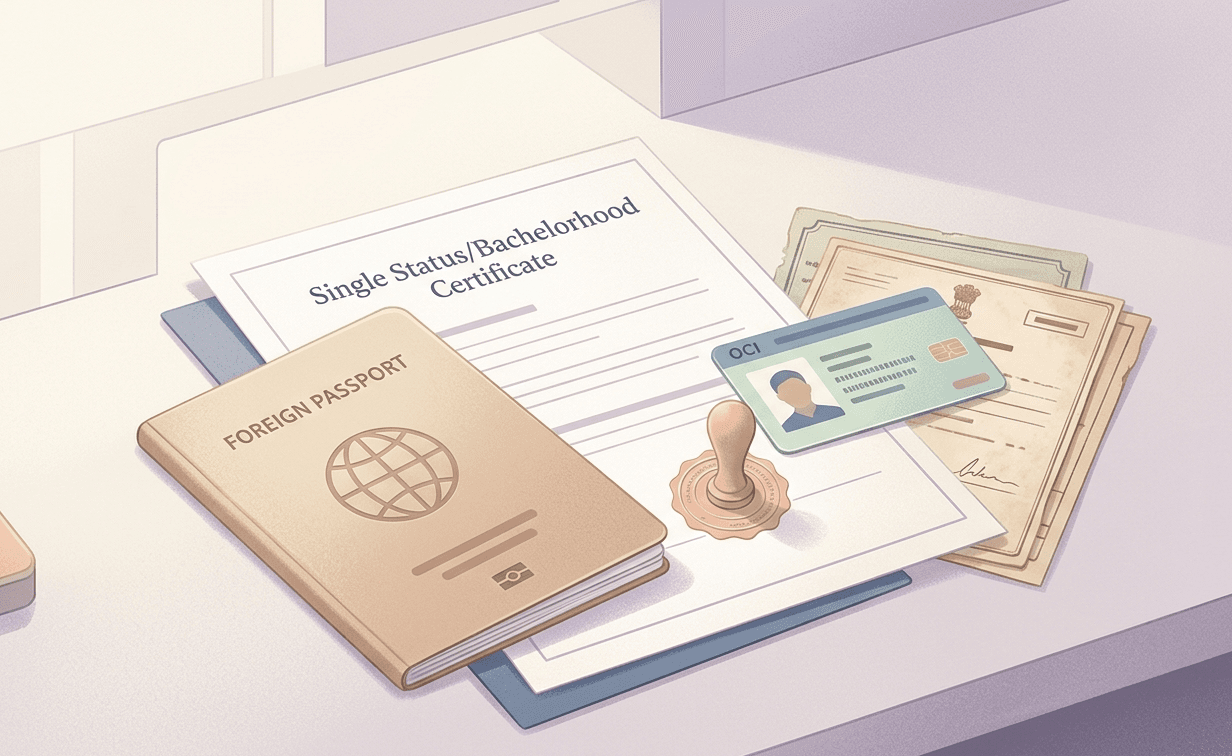
If you were born abroad to Indian parents, grew up holding only a US, UK, Canadian, or Australian passport, and have never once carried an Indian one, the word "NRI" probably doesn't even feel like it applies to you. Yet the moment marriage paperwork enters the picture, second-generation Indians in this exact position keep running into the same document request: a bachelorhood certificate from India. The natural question follows immediately — can you even get one if you've never held Indian citizenship?
The short answer is that it depends on what you actually need the document for, and the longer answer explains why that distinction matters more than most people realise.
What a Bachelorhood Certificate Actually Requires
A bachelorhood certificate — also known as a single status certificate or unmarried certificate — is issued through a fairly specific Indian bureaucratic chain: a notarised affidavit, attestation by the Sub-Divisional Magistrate (SDM) with jurisdiction over the applicant's address, counter-attestation by the state Home Department, and a final Ministry of External Affairs apostille or attestation for use abroad.
The catch for second-generation applicants sits right at the start of that chain. The SDM jurisdiction is typically determined by the address listed on the applicant's Indian passport. If you've never held one, there's no Indian address on file, no passport number to reference, and no obvious jurisdiction to route the application through — which is exactly where the process breaks down for people in your position.
Who Actually Needs This Certificate?
Before assuming you need to chase down an Indian bachelorhood certificate at all, it's worth stepping back and asking why the document was requested in the first place. In almost every case, it's because a foreign marriage registrar or immigration authority wants proof, from your country of citizenship, that you're legally free to marry. That country is the one issuing your passport — not India.
If you're a second-generation NRI with, say, a British or Canadian passport, the marriage registrar in the country where you're marrying generally wants a single-status document from the UK or Canada, not from India. The Indian bachelorhood certificate becomes relevant almost exclusively when India itself is the country reviewing your marital status — for instance, marrying in India, registering a marriage under Indian law, or dealing with an authority that specifically wants proof tied to Indian family origin rather than current citizenship.
When You Genuinely Don't Need an Indian Certificate
For most second-generation NRIs marrying in their country of citizenship, or in a third country, the practical answer is straightforward: use your own country's single-status documentation, not an Indian one. A US-born applicant typically provides a sworn affidavit before a notary; a UK-born applicant applies for a Certificate of No Impediment through their local register office; an Australian-born applicant follows the equivalent process through Australian authorities.
This is often the cleanest path, because it avoids the jurisdictional gap entirely — your home country already has an established, citizenship-based process that doesn't require any Indian documentation at all.
When an Indian Bachelorhood Certificate Still Comes Into Play
There are specific scenarios where a second-generation NRI genuinely does need something from India:
Marrying in India itself. If the wedding — civil or religious — is taking place in India, Indian authorities may expect documentation tied to your family's Indian records, particularly if you're marrying under a framework like the Special Marriage Act.
One partner is an Indian citizen and Indian marriage registration is required. Where the Indian partner needs the marriage recorded under Indian civil law, having a matching document from the OCI or PIO side can smooth that registration, even though it isn't always mandatory.
The destination country specifically asks for documentation reflecting Indian heritage. This is rare but does happen — usually in cases involving religious ceremonies or cultural marriage frameworks that reference ancestral nationality rather than current citizenship.
Can an OCI or PIO Cardholder Apply at All?
This is where things get more workable than the SDM jurisdiction problem initially suggests. Overseas Citizen of India (OCI) cardholders — a category available to children, grandchildren, and even great-grandchildren of Indian citizens — are not Indian citizens, but they do have a recognised, documented relationship with India that opens up alternative routes.
Indian missions abroad generally allow OCI cardholders to apply for a Single Status Certificate directly through the embassy or consulate in their country of residence, using their OCI card, foreign passport, and supporting proof of Indian origin — often a parent's or grandparent's Indian passport, birth certificate, or naturalisation record — in place of an Indian passport number. This route sidesteps the domestic SDM jurisdiction issue by keeping the entire process consular rather than routing it through a physical Indian address.
Step-by-Step: Applying as a Second-Generation NRI with OCI Status
-
Confirm you actually need the document. Check with the destination marriage registrar whether they want a certificate from your country of citizenship or specifically one referencing Indian origin.
-
Gather proof of Indian origin. This typically includes a parent's or grandparent's Indian passport, birth certificate, or an old PIO card, alongside your OCI card if you hold one.
-
Draft the affidavit. Declare your single or divorced/widowed status, along with personal details, your foreign passport number, and your parents' names.
-
Have it notarised. This can usually be done before a local notary in your country of residence, or directly at the Indian consulate handling your application.
-
Submit to the Indian Embassy or Consulate. Since there's no Indian SDM jurisdiction to route through, the consular post in your country of residence typically handles the verification directly.
-
Request apostille or attestation as needed. Depending on the destination country's Hague Convention status, the consulate can guide you toward the correct final authentication step.
What If You Don't Hold an OCI Card?
If you're a second-generation NRI without OCI status — perhaps because your family never applied, or because a parent's origin traces to a region or era that complicates eligibility — the Indian route becomes considerably harder to pursue directly. In that situation, the most practical option is almost always to rely entirely on your country of citizenship's own single-status process, since that document is what most foreign registrars actually expect regardless of family heritage.
It's worth double-checking eligibility before assuming this door is closed, though. OCI registration extends fairly far down the family tree, and many second-generation applicants qualify without realising it, simply because they never looked into the criteria.
Costs and Timelines to Expect
For second-generation NRIs going the OCI consular route, expect the process to take a few weeks rather than days, largely because gathering a parent's or grandparent's original Indian documents can be the slowest step, especially if those records are decades old or were never digitised. Consular fees for the affidavit and certificate itself are typically modest, but courier costs for original supporting documents and any translation requirements can add to the total, particularly if the destination country's civil registry insists on documents in its own language.
By contrast, applicants who go through their country of citizenship's own single-status process — the more common and often faster path — usually find the timeline closer to what any other citizen of that country would experience, since it doesn't involve cross-border document retrieval at all.
Common Mistakes in This Situation
-
Assuming "NRI" automatically means eligible for standard Indian documentation. The standard bachelorhood certificate process is built around Indian passport holders; second-generation applicants without one need a different route.
-
Not checking OCI eligibility before ruling out the Indian option. Many applicants are eligible through a parent or grandparent and don't realise it.
-
Requesting an Indian certificate when the destination country never asked for one. This wastes time and consular appointments on a document that wasn't required in the first place.
-
Missing the proof-of-origin documents. Consular applications for OCI-based single status certificates move much faster when the parent's or grandparent's Indian records are gathered upfront.
Final Thoughts
Being a second-generation NRI without an Indian passport doesn't shut the door on getting Indian-linked documentation — it just changes which door you knock on. In most cases, your own country's single-status process is the right and simpler answer. But where India genuinely needs to be part of the picture, an OCI card and solid proof of your family's Indian origin generally open a workable consular pathway, even without ever having held an Indian passport yourself. The key is figuring out early which document the destination actually requires, rather than defaulting to the assumption that "NRI" means the standard Indian bachelorhood certificate process applies to you the same way it would to someone who grew up with an Indian passport in hand.
Frequently Asked Questions
1. Does holding an OCI card make me an Indian citizen for this purpose?
No. An OCI card confirms a documented connection to India and unlocks certain consular services, including this one, but it does not confer Indian citizenship or an Indian passport.
2. Will Indian authorities accept my foreign birth certificate as proof of Indian origin?
Generally not on its own. Proof of origin usually needs to trace back to a parent's or grandparent's Indian passport, birth certificate, or citizenship record, since your own foreign birth certificate only confirms where you were born, not your family's Indian background.
3. What if my parents' Indian records were lost or never existed in a retrievable form?
This is one of the more common obstacles for second-generation applicants. In these cases, it's worth consulting the specific Indian consulate handling your application, since some accept secondary evidence such as old ration cards, school records, or affidavits from extended family confirming lineage.