
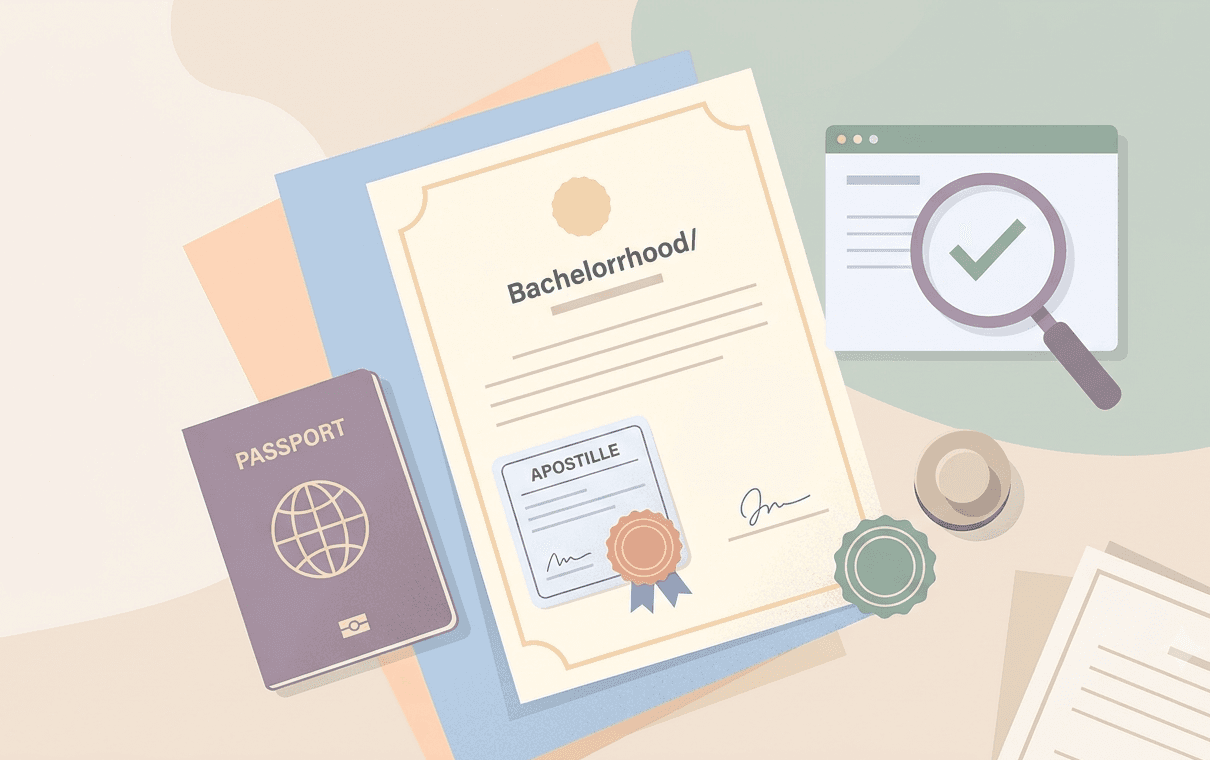
Most guides on the Indian bachelorhood certificate stop at "get it apostilled, and you're done." What they skip over is the part that actually determines whether your marriage registration goes through smoothly: what happens on the other end, once a foreign civil registrar, embassy officer, or immigration authority actually receives your document and has to decide whether to trust it.
Understanding that verification process — not just the steps to obtain the certificate, but how it gets checked once it lands on someone else's desk — is what separates couples who sail through registration from those stuck explaining a rejected document weeks before their wedding date.
What a Foreign Registrar Is Actually Checking For
When a foreign marriage registrar receives an Indian bachelorhood certificate, they're not evaluating whether you're telling the truth about your relationship status in some abstract sense. They're checking three specific things: that the document was genuinely issued by a legitimate Indian authority, that the chain of signatures and seals authenticating it is unbroken, and that every personal detail on the certificate lines up exactly with your passport and other supporting documents.
This is a narrower question than it sounds. A registrar isn't investigating your life story — they're verifying a paper trail. And that paper trail either holds together or it doesn't.
The Apostille: The First Thing Registrars Look For
For countries that are members of the Hague Apostille Convention, the single most important verification point is the MEA apostille itself — a computer-generated sticker affixed to your bachelorhood certificate by India's Ministry of External Affairs. This apostille confirms the authenticity of the signature, seal, and authority of the Indian official who issued the underlying certificate. It does not, notably, verify the content of the document — only that the officials who signed off on it were who they claimed to be.
Every MEA apostille carries a unique identification number. This is the detail that makes independent verification possible at the other end.
How Registrars Verify the Apostille Online
Here's the part most couples never see happen: once your certificate arrives at a foreign civil registry or embassy, an officer can independently confirm its authenticity without ever picking up a phone or writing to India. They do this through one of two channels.
The MEA's own verification portal. Foreign authorities can enter your apostille number, issue date, and destination country directly into India's official apostille verification system, apostille.mea.gov.in, and receive confirmation within seconds. This portal exists precisely because so many receiving countries need a fast, tamper-proof way to confirm an apostille is real.
The HCCH Apostille Register. For countries operating under an electronic apostille program, registrars can cross-check the certificate against the Hague Conference's own international register, which lists issued apostilles from participating countries.
If either check comes back empty, or the details don't match what's printed on your certificate, the document is treated as unverifiable — and unverifiable, in this context, functions identically to invalid.
What Happens for Non-Hague Destination Countries
Not every country your Indian bachelorhood certificate might need to travel to is a Hague Convention member. In these cases, the apostille shortcut doesn't apply, and verification runs through a more traditional embassy attestation chain instead.
For non-Hague destinations, the certificate typically needs direct legalisation by the destination country's embassy or consulate in India, layered on top of the standard Indian attestation steps. This means the registrar on the receiving end isn't checking an online database at all — they're relying on their own embassy's physical stamp, applied by their own diplomatic staff in India, as the verification mechanism. It's slower, but it shifts the trust question away from a database lookup and onto a signature their own government has already vetted.
The Attestation Chain Registrars Rely On
Even before the apostille or embassy stamp comes into play, the certificate has already passed through several layers of Indian authentication, and registrars implicitly rely on this chain holding together:
-
Notarisation. A notary public verifies the applicant's identity and witnesses the affidavit.
-
State-level authentication. Either the Sub-Divisional Magistrate or the state Home Department authenticates the notary's signature, depending on the issuing state's procedure.
-
MEA apostille or attestation. The Ministry of External Affairs applies the final layer, authenticating the state-level signature and seal.
A foreign registrar generally isn't inspecting each of these individual signatures — they're trusting that the final MEA stamp wouldn't exist unless the earlier steps were properly completed. This is exactly why skipping or rushing an earlier step in the chain, even if the final apostille gets issued, can create problems if a registrar ever looks closely enough to notice something inconsistent in the underlying paperwork.
Cross-Checking Personal Details Against Your Passport
Beyond authenticating the stamps and signatures, registrars pay close attention to something far more mundane and far more common as a rejection trigger: whether your name, date of birth, and other identifying details on the bachelorhood certificate match exactly what's printed in your passport.
This sounds like a formality, but it's consistently one of the most frequent reasons documents get sent back. A registrar's entire verification process assumes the person named on the certificate is the same person standing in front of them — and even a minor spelling variation, a missing middle name, or an initial written differently can break that assumed continuity. Registrars aren't equipped to guess whether a mismatch is an innocent clerical error or something more serious, so most simply won't proceed until it's resolved.
Why Registrars Also Check the Certificate's Age
Most foreign authorities won't accept a bachelorhood certificate indefinitely. Since the document only confirms your marital status as of its issue date, registrars typically enforce a validity window — commonly three to six months, though some countries require issuance within a much tighter ninety-day range. A registrar checking the issue date against their own country's requirement is effectively asking whether the "snapshot" of your marital status is still recent enough to be trusted.
Common Reasons Registrars Reject an Indian Bachelorhood Certificate
-
Apostille or attestation missing entirely. A certificate submitted without the final authentication layer is rarely accepted, regardless of how complete the underlying paperwork looks.
-
Name mismatches across documents. Differences between the certificate, the passport, and any supporting affidavit are the single most common rejection trigger.
-
Expired validity window. A certificate issued too far in advance of the marriage application gets treated as stale, even if nothing about the applicant's status has changed.
-
Broken attestation chain. If state-level authentication was skipped or improperly obtained before the MEA stamp was applied, the entire chain can be flagged as invalid once scrutinised.
-
Translation inconsistencies. Where a certified translation is required, discrepancies between the translated version and the original English or Hindi text can raise the same red flags as a name mismatch.
How Couples Can Reduce the Risk of Rejection
-
Double-check every name spelling against your current passport before submission, including any "also known as" notes for documents where variations already exist.
-
Confirm your destination country's specific validity window before applying, rather than assuming a universal three-to-six-month rule applies everywhere.
-
Verify Hague Convention status for your destination early, since it determines whether you need an apostille or full embassy legalisation.
-
Keep the apostille number accessible when submitting your documents, since some registrars will ask for it explicitly to run their own verification check.
-
Avoid shortcuts at the state-authentication stage, even if a service provider offers to speed things up — a weak link early in the chain can surface unexpectedly at the very end.
Final Thoughts
The Indian bachelorhood certificate isn't just a piece of paper that gets rubber-stamped and forgotten — on the receiving end, it goes through a genuine, often database-backed verification process designed to catch exactly the kinds of inconsistencies that seem minor until they aren't. Understanding how that verification actually works, from the MEA's online apostille portal to the quiet but consistent scrutiny of name spellings, gives couples a real advantage: the ability to catch a problem before a registrar does, rather than after.
Frequently Asked Questions
1. Can a foreign registrar verify an Indian bachelorhood certificate without contacting India directly?
Yes, in most cases. For Hague Convention countries, the online MEA verification portal and the HCCH Apostille Register allow registrars to confirm authenticity independently, without needing to correspond with any Indian office.
2. Does the apostille verify that I'm actually unmarried, or just that the document is real?
Just that the document is real. The apostille authenticates the signatures and seals in the attestation chain — it doesn't independently investigate or confirm the factual claims made in the underlying affidavit.
3. What should I do if a registrar says they can't verify my apostille?
First, confirm the apostille number is being entered correctly, since a single-digit error can produce a false negative. If the number genuinely doesn't return a match, it's worth checking directly with the MEA or the outsourced agency that processed your application, since this can occasionally indicate a processing error rather than a fraudulent document.
4. Is embassy-attested documentation treated as less trustworthy than an apostille?
Not necessarily less trustworthy — just verified differently. Embassy attestation relies on the receiving country's own diplomatic staff having already vetted the document in India, rather than a registrar independently checking an online database themselves.