
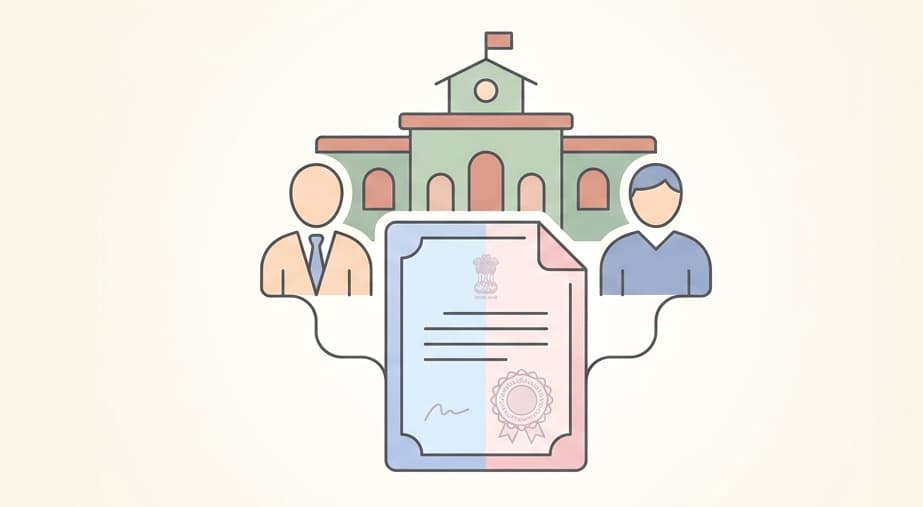
Many NRIs assume the bachelorhood certificate is issued by a single authority, like a government department that prints and stamps it. The reality is more nuanced — the certificate is built up through a multi-tier process involving notaries, magistrates, state departments, and the Ministry of External Affairs. Understanding the hierarchy helps you avoid procedural mistakes and identify which authority handles which step.
The Four-Tier Attestation Hierarchy
The complete bachelorhood certificate process for international use involves four tiers of authority, each adding a layer of legal validation:
Tier 1: Notary Public
The notary public is the foundational authority. A registered notary attests the applicant's signature on the affidavit and confirms the contents are sworn before them. The notary uses a ₹100 non-judicial stamp paper, applies their seal, and signs the document. Without this initial step, no further attestation is possible.
Only a notary who is registered with the appropriate state government can perform this function. Document signing by an unregistered notary is invalid and will fail at subsequent attestation steps.
Tier 2: Sub-Divisional Magistrate / Tehsildar / Executive Magistrate
The SDM is the second-tier authority. After notarization, the affidavit is submitted to the SDM having jurisdiction over the applicant's last permanent address in India. The SDM verifies the notarization, checks the applicant's identity (in person or through documents), and counter-attests the affidavit. This step bridges local notarization with state-level recognition.
In some states, this role is filled by the Tehsildar or Executive Magistrate. The functional equivalence is the same, but the title varies by state.
Tier 3: State Home Department / GAD
After SDM attestation, the document is submitted to the state's Home Department or General Administration Department for state-level attestation. This step is required for international use of the document but not for purely domestic use. State Home Departments verify the SDM's authority and add the state government's attestation.
Processing times at state level vary significantly. Delhi is typically the fastest (3-5 working days). Maharashtra, Karnataka, and Tamil Nadu run 5-7 working days. Some smaller states or those with manual processes can take 7-10 working days.
Tier 4: Ministry of External Affairs Apostille
The final step for Hague Convention countries is MEA apostille. MEA verifies all prior attestations and adds an internationally-recognized apostille sticker. This step makes the document legally usable in any of the 120+ Hague signatory countries without further legalization.
MEA apostille is processed at the MEA office at CGO Complex in Delhi or through authorized agencies. Same-day apostille is sometimes available; standard processing is 1-3 working days.
When Indian Embassies Abroad Are the Issuing Authority
Indian Embassies and Consulates abroad can issue bachelorhood certificates directly for Indian citizens residing in their jurisdiction. This is an alternative to applying through India. The embassy route is slower (typically 2-6 weeks) and may require multiple in-person visits. Most NRIs find the India-side service provider route faster and easier.
Embassies that handle this commonly include:
▪ Embassy of India, Washington DC (and Consulates in New York, Chicago, San Francisco, Houston, Atlanta).
▪ High Commission of India, London (and offices in Birmingham, Edinburgh).
▪ Consulate General of India, Dubai (also Abu Dhabi).
▪ High Commission of India, Ottawa (and Consulates in Toronto, Vancouver).
▪ High Commission of India, Canberra (and Consulates in Sydney, Melbourne, Perth).
▪ High Commission of India, Singapore.
Non-Hague Countries: Additional Embassy Attestation
For non-Hague Convention countries (some African nations, certain Middle Eastern countries pre-2021, China), MEA apostille is insufficient. The document additionally requires attestation by the destination country's embassy in India. This adds another tier and 5-10 working days to the timeline.
Why the Hierarchy Matters
Each tier validates the prior tier. A notary cannot vouch for an SDM; an SDM cannot vouch for state attestation; the state cannot vouch for MEA. Skipping any tier results in the document being rejected at subsequent steps or by the foreign authority. The hierarchy is not bureaucratic redundancy — it is a chain of trust that gives the document international legal weight.
For complete details on bachelorhood certificates and the legal process in India, visit our Bachelorhood Certificate Page.
Frequently Asked Questions
1. Can a notary alone issue a bachelorhood certificate?
A notary can attest the affidavit, but for international use you need further attestation by SDM, state Home Department, and MEA apostille. A notary-only document is not sufficient for most foreign authorities.
2. Is SDM attestation mandatory?
For most foreign countries that require this document, yes. SDM attestation is the bridge between local notary attestation and MEA apostille. Without it, the chain of validation breaks.
3. Which SDM should I approach?
The SDM having jurisdiction over your last permanent address in India. Service providers can sometimes arrange flexibility on jurisdiction, but as a default, use the SDM where your address is registered.
4. Do I need both apostille and embassy attestation?
Only for non-Hague Convention countries. For Hague countries (USA, UK, Canada, Australia, most of Europe), MEA apostille alone is sufficient. For non-Hague countries, additional embassy attestation is required.