
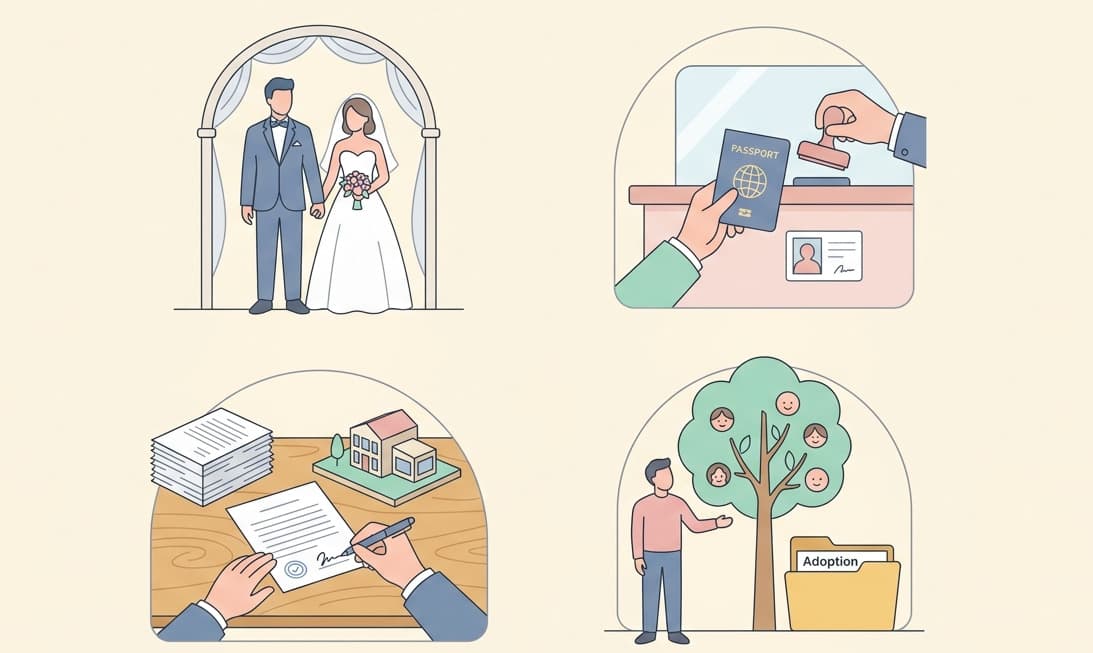
Many NRIs encounter the bachelorhood certificate requirement at the last moment — usually when an embassy, registrar, or immigration officer asks for it during a marriage or visa application. By then, the time pressure adds stress to an already complex process. Understanding upfront when this document is needed lets you plan months ahead and avoid last-minute scrambles.
Below are 12 real-life scenarios where Indian citizens and NRIs need a bachelorhood certificate, with practical context for each.
Scenario 1: Marrying a Foreign National Abroad
This is the most common scenario. When an Indian citizen marries a non-Indian in any foreign country, the local registrar or marriage authority requires proof that the Indian party is legally eligible to marry. Civil-law countries — Germany, France, Italy, Spain, Switzerland, the Netherlands — strictly enforce this requirement. Common-law countries — the US, UK, Canada, Australia — typically accept a sworn affidavit but often request the bachelorhood certificate as supporting evidence.
Scenario 2: K-1 Fiancé Visa for the United States
The K-1 visa allows a US citizen to bring a foreign fiancé to the US for marriage within 90 days of arrival. USCIS requires evidence that both parties are legally free to marry. For the Indian fiancé, an apostilled bachelorhood certificate from India is the cleanest documentary proof. While a sworn affidavit before a US notary is sometimes accepted, the Indian-issued certificate streamlines the K-1 application.
Scenario 3: Spouse / Settlement Visa Applications
UK settlement visas, Australian partner visas (subclass 309/100 and 820/801), Canadian spousal sponsorship, and similar categories often request a bachelorhood certificate as part of the relationship-eligibility evidence package. This is especially the case when the relationship has not yet been registered as a marriage.
Scenario 4: Marriage Registration in Civil-Code Countries
Countries with civil-code legal systems require formal pre-marriage registration. The local civil registrar — Standesamt in Germany, comune in Italy, mairie in France, Registro Civil in Spain — requires the bachelorhood certificate apostilled and translated by a sworn translator. Without this document, the marriage cannot proceed.
Scenario 5: Court Marriage Abroad
Many countries offer civil court marriages as an alternative to religious ceremonies. Court marriages typically have stricter documentary requirements than religious ones, and the bachelorhood certificate is almost always required.
Scenario 6: Embassy and Consulate Procedures
Indian Embassies abroad sometimes issue their own version of the bachelorhood certificate or require an Indian-issued one when assisting an NRI with marriage abroad. The exact requirement varies by embassy.
Scenario 7: Religious Marriage Abroad
Churches, mosques, synagogues, and gurdwaras in foreign countries may require evidence that both parties are unmarried before performing religious ceremonies. While these requirements are not legal mandates, they are institutional requirements that must be met.
Scenario 8: Permanent Residence and Immigration Applications
Some PR routes are based on relationship status — marriage, partnership, or fiancé status. Immigration authorities may request the bachelorhood certificate as part of the application package, particularly if the principal applicant is unmarried at the time of filing.
Scenario 9: Adoption Proceedings Abroad
Single-applicant international adoption sometimes requires proof that the applicant is currently unmarried. The bachelorhood certificate satisfies this requirement.
Scenario 10: Surrogacy Applications
Single intended parents pursuing international surrogacy may need to prove their single status. The bachelorhood certificate is used in this context.
Scenario 11: Inheritance and Succession Claims Abroad
In rare cases, inheritance disputes or succession claims in foreign jurisdictions require proof that the claimant is or was unmarried at certain points.
Scenario 12: Background Verification for Sensitive Employment
Some defense, diplomatic, or high-security employment categories abroad request formal documentation of marital status. The bachelorhood certificate is one element of such background verification.
When You Don't Need a Bachelorhood Certificate
Equally important is knowing when this document is not needed. You generally do not need it for:
▪ Marriage between two Indian citizens inside India.
▪ Tourist visas, business visas, or work visas.
▪ Education or student visas.
▪ Most non-relationship-based immigration.
For complete details on bachelorhood certificates and the legal process in India, visit our Bachelorhood Certificate Page.
Frequently Asked Questions
1.Do all countries require a bachelorhood certificate for marriage?
No. Civil-code countries like Germany, France, Italy, Spain, and Switzerland require formal certificates. Common-law countries like USA, UK, Canada, and Australia sometimes accept a sworn affidavit, though most still request the Indian apostilled bachelorhood certificate as supporting evidence.
2. Can I apply for a spouse visa without a bachelorhood certificate?
It depends on the country and specific visa category. Some embassies require it as supporting evidence; others accept divorce decrees or birth-based marital status proof. Check your specific embassy's requirements before assuming it's optional.
3. Do I need a bachelorhood certificate if I'm already engaged but not yet married?
Yes — being engaged does not change marital status. As long as you are not legally married, you remain single for documentation purposes, and the bachelorhood certificate confirms this.
4. Is the bachelorhood certificate needed for tourist or work visas?
No. Tourist, work, and education visas do not depend on marital status, so this document is not required for those categories.