
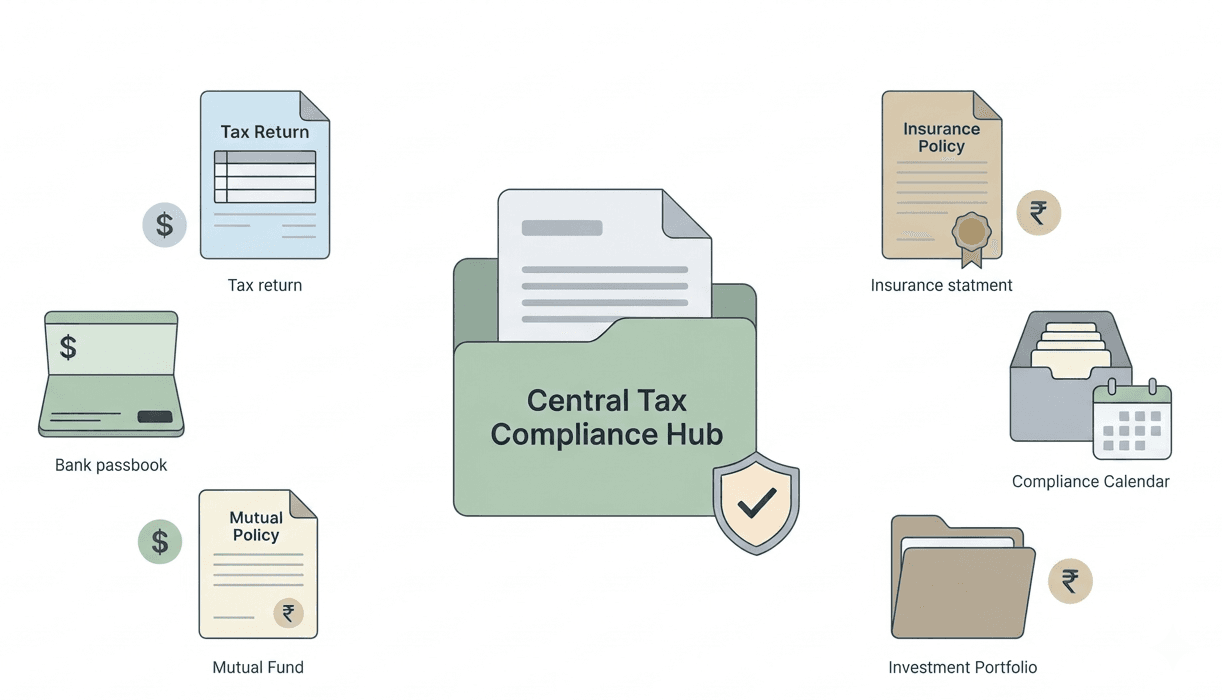
If you're an NRI living and working in the USA — on an H1-B, L1, or as a Green Card holder — there's a good chance you filed your US tax return every year without knowing that your Indian NRE and NRO accounts, your mutual fund folios, your LIC policies, and even your Demat/brokerage holdings back home were reportable to the IRS.
This isn't a rare oversight. It's the single most common compliance gap among NRIs in the USA. Most CPAs who prepare US returns have never worked with Indian financial products and simply don't know that:
- NRE and NRO fixed deposit interest, though tax-free in India, is fully taxable in the USA
- Foreign mutual funds (including funds bought by your spouse in India) are classified by the IRS as PFICs (Passive Foreign Investment Companies) and trigger their own reporting form
- LIC policies with cash value may need to be reported on your FBAR
- Foreign accounts and investments over certain thresholds require FBAR (FinCEN Form 114) and Form 8938 (FATCA) filings — every single year they existed
If you've just realized this applies to you, you are not in trouble yet — but the fix has a name, a process, and a deadline that starts the moment you know. That fix is called SDOP — the Streamlined Domestic Offshore Procedure — and it exists precisely for NRIs in this position. The single most important thing to understand is that you have to do SDOP before the IRS catches the gap on its own. Once that happens, the door to SDOP closes and the penalties get dramatically worse.
What Is SDOP (Streamlined Domestic Offshore Procedure)?
SDOP — the Streamlined Domestic Offshore Procedure — is an IRS amnesty program built specifically for US taxpayers, including NRIs, who failed to report foreign financial accounts and foreign income non-willfully, meaning the omission came from not knowing the rules, not from intentionally hiding assets. If your missed reporting involves Indian mutual funds, an NRE/NRO account, or an LIC policy, SDOP is very likely the program built for exactly your situation.
You are eligible to do SDOP if you meet three conditions:
- You are a US tax resident (H1-B holders who meet the Substantial Presence Test qualify for SDOP)
- Your failure to report was non-willful
- You have not already been contacted by the IRS about the accounts in question
If you qualify for SDOP, the procedure lets you:
- File amended returns for the 3 most recent tax years
- File FBARs for the 6 most recent years
- Pay a single 5% miscellaneous offshore penalty on the highest aggregate value of your unreported foreign accounts — instead of the far steeper penalties (up to 50% per year, per account) that apply if the IRS finds the gap before you do SDOP
For most NRIs sitting on unreported NRE/NRO accounts, mutual funds, and an LIC policy or two, doing SDOP now is dramatically cheaper — and dramatically less stressful — than waiting and hoping the IRS never notices.
What Counts as a "Foreign Account" for SDOP Purposes
If any of the following describe you, doing SDOP is worth a serious look:
- NRE or NRO savings, current, or fixed deposit accounts opened after moving to the USA (or even before, if the account stayed open)
- Mutual fund folios in India — including ones held in your spouse's name, if you file a joint US return
- Demat/brokerage accounts holding Indian stocks or ETFs
- LIC or other Indian insurance policies with a cash or surrender value
- Bank shares (yes — even nominal shares in a cooperative bank like Saraswat Bank count toward FBAR aggregation)
The IRS FBAR threshold is a combined $10,000 across all foreign accounts, at any point in the year — a threshold most NRIs cross without realizing it, sometimes from the NRE FD alone. Cross that threshold in any unreported year, and SDOP is almost certainly the right route back into compliance.
- The Part Almost Everyone Gets Wrong When They Do SDOP: PFIC Reporting on Indian Mutual Funds
- This is where most generic US tax preparers fall short on an SDOP filing — and where NRIs get the most expensive surprises.
Every Indian mutual fund scheme you (or your spouse) hold is treated by the IRS as a PFIC. Each fund requires its own Form 8621, for each year it was held — not one form for your whole portfolio. Hold 7 funds for 3 years, and you could be looking at 15–20 separate forms.
A few things NRIs should know before they start:
- QEF elections are almost never available for Indian mutual funds, because Indian AMCs don't issue the PFIC Annual Information Statement the election requires.
- Mark-to-Market elections may be usable going forward, but rarely retroactively
- Absent those elections, the default Section 1291 excess distribution regime applies — and it gets genuinely complex the moment there's been a redemption, switch, or SIP/STP transaction inside the fund. A fund you simply held untouched is far simpler to compute than one with monthly SIPs, STPs, or partial redemptions
- There is a $50,000 (joint) / $25,000 (single) aggregate value exception that can eliminate the Form 8621 requirement entirely for a given year — worth checking before assuming every fund needs a form every year
Ask any preparer quoting you an SDOP fee exactly how PFIC computation is priced — per fund, per form, or hourly. Section 1291 calculations on funds with activity (SIPs, STPs, redemptions) are genuinely labor-intensive, and this is the single biggest driver of surprise fees when NRIs do SDOP.
What the Non-Willfulness Certification Actually Requires (This Is What Makes or Breaks an SDOP Filing)
The centerpiece of an SDOP submission is Form 14654, the Certification of Non-Willfulness. This isn't a checkbox — it's a written narrative explaining, in your own factual circumstances, why the accounts weren't reported. A rushed or generic certification is the single most common reason an SDOP submission draws IRS scrutiny. This document deserves as much care as the tax computations themselves, because the entire benefit of doing SDOP hinges on the IRS accepting that the omission was genuinely non-willful.
SDOP vs. Doing Nothing: Why NRIs Shouldn't Wait
Some NRIs hear about SDOP and decide to wait — maybe next year, maybe after the next raise, maybe never. That's the costliest version of this decision. SDOP is only available before the IRS has contacted you about the accounts. The moment the IRS flags an unreported NRE account, mutual fund, or LIC policy on its own — through FATCA data-sharing with Indian banks, for instance — the SDOP door closes, and you're left facing per-year, per-account penalties that can run into tens of thousands of dollars, plus potential criminal exposure in willful cases. Doing SDOP now, while you still can, is the entire point.
What a Complete, Properly-Scoped SDOP Filing Includes
For NRIs in this situation, a full and defensible SDOP package should cover:
- Amended Form 1040-X for the 3 most recent covered years, including all previously unreported NRE/NRO interest, mutual fund dividends, and capital gains
- Form 8938 (FATCA) for each covered year, where thresholds are met
- FBARs (FinCEN Form 114) for the 6 most recent years, for every account holder — including a spouse, if joint accounts or investments are involved
- Form 8621 for every PFIC fund, every applicable year
- Form 14654 non-willfulness certification and offshore penalty computation
- A check on whether any of your India-side holdings (a resident Demat account or mutual fund folio bought after becoming a US resident) also raise a FEMA compliance question in India — a step most US-only preparers never even flag
Why This Can't Be a Generic US Tax Preparer's Job
SDOP filings for NRIs sit at the intersection of US tax law, Indian financial products, and (often) FEMA regulations in India. A preparer who doesn't work with NRE/NRO accounts, Indian mutual funds, and LIC policies regularly will either miss reportable assets, misclassify PFIC treatment, or under-scope the Section 1291 work — all of which can undo the protection SDOP is meant to offer.
Do SDOP Now — Next Step for NRIs
If you're an NRI in the USA — on H1-B, L1, or a Green Card — and you've never reported your NRE/NRO account, Indian mutual funds, LIC policies, or Demat holdings on your US return, the sooner you start SDOP, the better your position. The program is only available before the IRS contacts you, so the right time to do SDOP is now, not after a notice arrives.
Book a free consultation with our NRI tax team to get a clear, fixed-fee SDOP quote — including exactly how your PFIC/Form 8621 reporting will be handled — before you commit to anything.
India For NRI works exclusively with NRIs on SDOP, FBAR, FATCA, PFIC, and Streamlined Filing Compliance matters involving Indian mutual funds, NRE/NRO accounts, LIC policies, and property. [Talk to our tax team about doing SDOP →]