
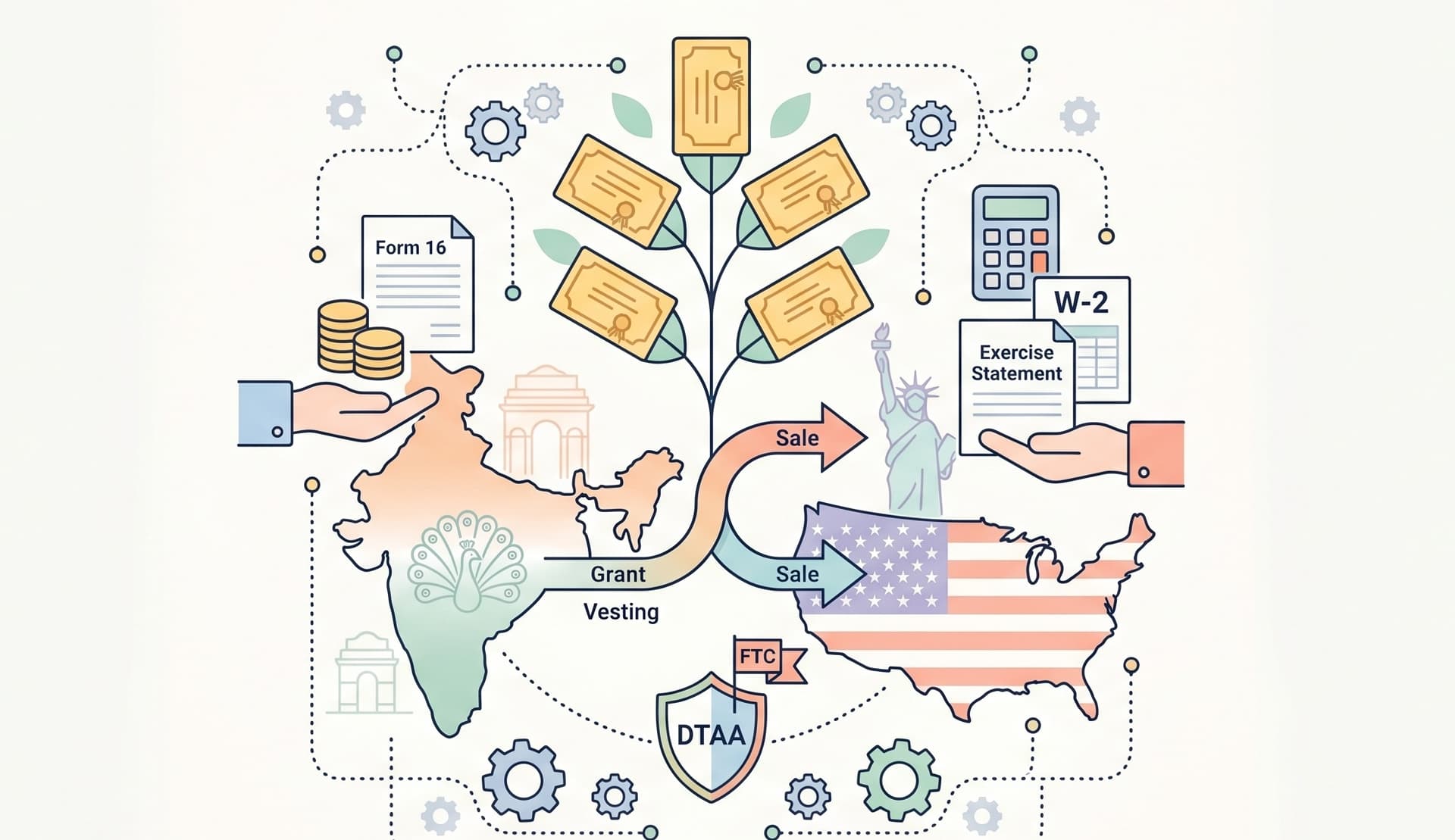
What triggers cross-border issues?
ESOPs have three taxable events: Grant (usually not taxable), Vesting/Exercise (taxable as salary), Sale (capital gain). Cross-border issues arise when grant happens in one country and vesting/sale in another.
How is ESOP taxed in India?
At exercise/vesting (whichever taxable per plan), FMV minus exercise price is perquisite under salary. Employer (if Indian) withholds TDS.
At sale:
- Listed Indian shares: STCG (≤12 months) at 20% / LTCG (>12 months) at 12.5% on gains over ₹1.25 lakh
- Unlisted Indian shares: STCG (≤24 months) at slab / LTCG (>24 months) at 12.5% without indexation
- Foreign-listed shares: STCG (≤24 months) slab / LTCG (>24 months) 12.5% without indexation
How is ESOP taxed in US?
Non-Qualified Stock Options (NSOs): At exercise, FMV minus exercise price = ordinary income on W-2. At sale, gain over exercise-date FMV = capital gain.
Incentive Stock Options (ISOs): No regular tax at exercise, but spread is AMT preference. Sale 2+ years from grant AND 1+ year from exercise = LTCG. Otherwise disqualifying disposition = ordinary income.
RSUs: Ordinary income at vesting.
ESPPs: Discount element at purchase + capital gain on sale.
ESOPs granted in India, exercised/sold in US
Most-mishandled scenario. Taxable amount at exercise is sourced based on grant-to-vest workdays:
- Worked entirely in India during grant-to-vest → India-sourced
- Worked partly in both → apportion based on workdays
- Worked entirely in US → US-sourced
When you move from India to US mid-vest, complex. We document workday allocation and claim FTC on Indian-sourced portion.
ESOPs granted in US, moved to India
Indian tax treats entire exercise as Indian salary perquisite if Indian tax resident at vest. May also be US-taxable if you were US person during grant-to-vest.
DTAA Article 16 (Dependent Personal Services) is the framework. Apportion based on workdays, claim FTC.
How does the company report?
US W-2 Box 1 includes exercise gain. India Form 16 should reflect Indian-resident portion as salary perquisite. If employer is US-based, often don't issue Indian Form 16 — you self-declare.
Documents needed
- ESOP grant letter with grant date, vesting schedule, strike price
- Exercise statement with FMV on exercise date
- Brokerage statement with exercise and sale dates
- Workday allocation log (if grant-to-vest spanned countries)
- Indian Form 16 + W-2
Common ESOP cross-border mistakes
- Reporting full exercise gain in only one country
- Missing US tax on Indian-granted ESOPs vested in US
- Missing India tax on US ESOPs vested in India
- Not claiming FTC
- Forgetting India taxes FMV at exercise, US may tax differently
Planning tip — moving while ESOPs vest
Time matters. Pre-move:
- Calculate which country has lower effective tax rate on unvested ESOPs
- Consider accelerating exercise (where allowed) before move if move increases tax
- Document workdays carefully — key audit-defense
- Align US/Indian payroll teams on withholding
Explore our complete US Tax Return Guide to understand refunds, filing rules, and IRS procedures for NRIs.