
What is FATCA?
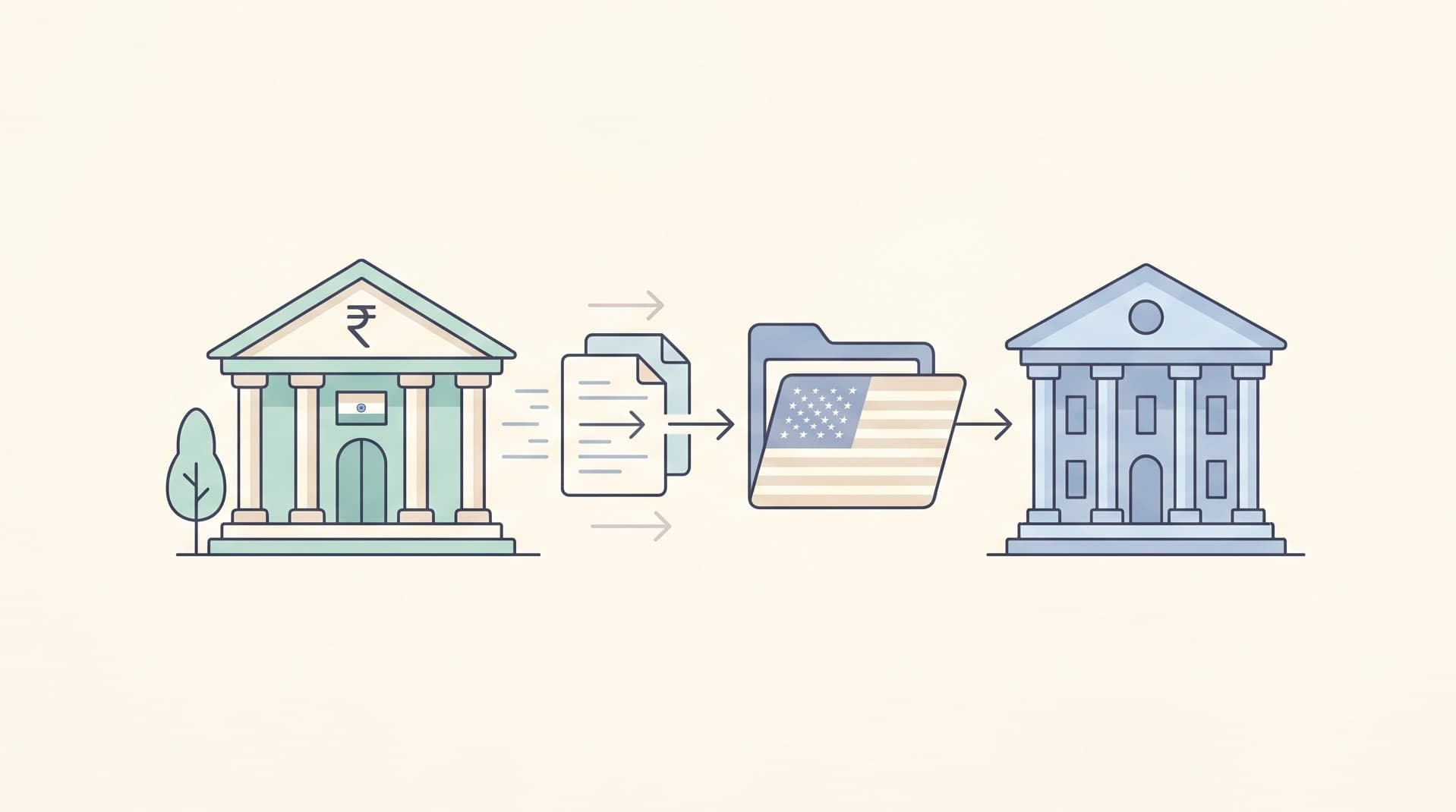
The Foreign Account Tax Compliance Act (FATCA) is a US law enacted in 2010 requiring foreign financial institutions to report US-person account holders directly to the IRS. India and US signed an Inter-Governmental Agreement (IGA) in 2015 to facilitate exchange.
Effective from 2015, all Indian banks, mutual fund companies, and demat brokers MUST identify and report US-person accounts to Indian tax authorities, who forward to IRS.
What does the bank report?
For each identified US-person account:
- Account holder name, address, TIN (SSN/ITIN)
- Account number
- Year-end balance
- Interest, dividends, gross proceeds credited
- Gross redemptions (for mutual funds)
Summary data, not transaction detail. But enough for IRS to know:
- Account exists
- Exceeds reporting threshold
- Earning income
How does the bank know I'm a US person?
When you opened the account or in periodic KYC refreshes, you signed self-certification (Form FATCA-CRS). It asks:
- Are you a US citizen?
- Are you a US Green Card holder?
- Are you a US tax resident under SPT?
- US TIN (SSN/ITIN)?
If YES, you're flagged as US person.
If NO but bank has "US indicia" — US address, US phone, US-place-of-birth — they may treat as US person pending clarification.
What if I lied or didn't update FATCA self-certification?
Bank reporting still happens based on what they have. The IRS receives data with whatever name/TIN they have. If wrong, creates mismatches IRS investigates.
Best practice: Keep FATCA self-certification up to date. Re-certify when status changes.
FATCA vs FBAR
FATCA = bank reports to IRS.
FBAR = you self-report to FinCEN.
Different agencies, different reports, similar information. IRS cross-checks FBAR against FATCA. If FBAR shows fewer accounts than FATCA data, IRS investigates.
What if my FBAR doesn't match FATCA data?
IRS sends notice (often CP2000 or FATCA-specific). They demand explanation or amendment.
Common mismatch causes:
- Forgot an account
- Joint account but only spouse declared FBAR
- Bank's TIN file is stale
- Aggregate calculation differences
We handle these notices for $350+ (CP2000 response).
Penalty regime
FATCA non-compliance by financial institution: Big fines on institution.
FATCA non-compliance by account holder (failing to file Form 8938): $10,000+ per return, plus 40% accuracy penalty.
Bank reporting doesn't penalize you — your failure to disclose on Form 8938 does.
How to think about FATCA
Assume IRS already knows about your Indian accounts. Your job is to disclose via FBAR + Form 8938 + properly report income.
Voluntary disclosure (current + retroactive via Streamlined) almost always beats waiting for IRS.
US Green Card holder living in India
Indian banks still report you via FATCA. Your GC makes you US person for FATCA.
If you've been ignoring US tax filing because you "live in India" — FATCA has been silently building a case. Streamlined Procedure is the way out.
Practical advice
- Always self-certify accurately on FATCA forms
- Match FBAR and Form 8938 reporting to what banks would report
- If past non-disclosure exists, use Streamlined Procedure
- Update banks promptly if status changes
- Don't try to hide accounts — FATCA caught up with offshore tax evasion
Explore our complete US Tax Return Guide to understand refunds, filing rules, and IRS procedures for NRIs.