
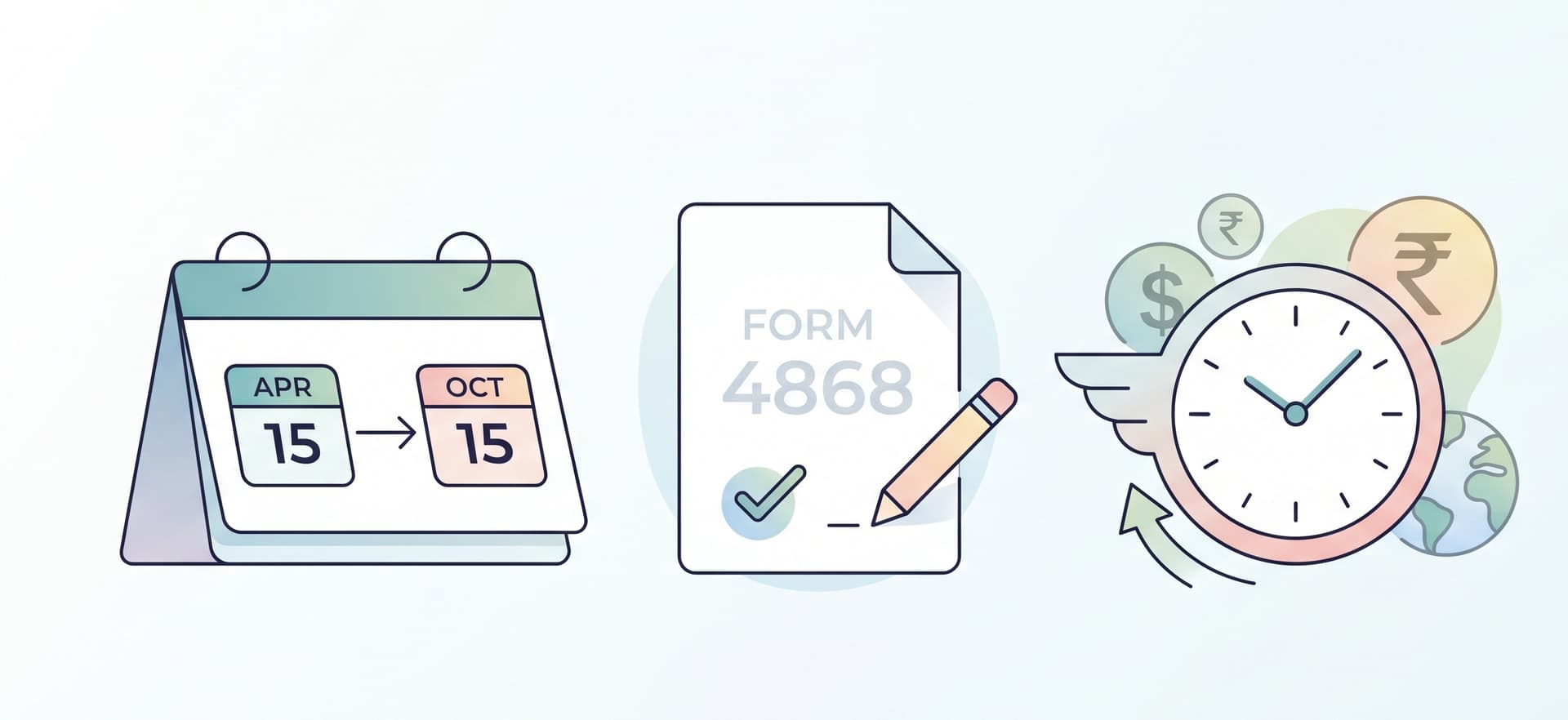
Filing extension vs payment extension
Critical distinction:
- Filing extension: Gives more time to FILE return
- Payment extension: NOT automatic — interest and penalties on unpaid tax run from April 15
Filing extension doesn't extend the time to pay.
Standard filing extension (Form 4868)
Form 4868 grants automatic 6-month extension to file:
- New deadline: October 15
- Must file Form 4868 by April 15 (your original deadline)
- Estimate your tax liability and pay any amount due
- Penalty-free filing extension; interest on underpayment
Automatic 2-month extension for those abroad
If you're a US citizen or resident who lives outside the US on April 15, you get automatic 2-month extension to June 15:
- No form required
- Attach a statement explaining why you qualify for an abroad extension
- Interest still accrues from April 15
To get further extension beyond June 15: file Form 4868 by June 15 for an additional 4 months to October 15.
Combined NRI extension timeline
NRI living in India who qualifies for an overseas extension:
- April 15: Statement attached for 2-month abroad extension → June 15
- June 15: File Form 4868 for additional extension → October 15
- October 15: Final deadline
In rare circumstances, taxpayers abroad can request additional discretionary 2-month extension to December 15 (Form 2350 or letter). Discretionary, IRS may deny.
FBAR extension
FBAR (FinCEN Form 114) deadline is April 15 with automatic 6-month extension to October 15 — no separate form needed.
Most NRIs use the full extension automatically without filing anything.
Penalty regime
Failure-to-file penalty: 5% of unpaid tax per month, capped at 25%.
Failure-to-pay penalty: 0.5% per month, capped at 25%.
Combined: Up to 47.5% of unpaid tax.
Interest: ~7-8% annual rate, compounded daily, from April 15.
Failure-to-file is 10x failure-to-pay rate. ALWAYS file extension, even if you can't pay.
Worked example
You owe $10,000 in tax. Don't file. Don't pay. Six months later:
Failure-to-file (6 months × 5%): $3,000 Failure-to-pay (6 months × 0.5%): $300 Interest: ~$400 Total: $3,700 in penalties + interest on $10,000 tax
If you'd filed extension and paid $10K by October 15: Failure-to-file: $0 Failure-to-pay: $0 (assuming paid by Oct 15) Interest from April 15: ~$400
Savings from filing extension: $3,300.
What if I can't estimate my tax?
When filing Form 4868, estimate as best you can. Pay at least:
- 100% of last year's tax, OR
- 90% of current year's expected tax
If you underpay, interest accrues but failure-to-pay penalty may be waived.
State extensions
State income tax extensions vary:
- Some states grant automatic extension if federal extension filed
- Others require separate state extension
- Check each state where you have filing obligations
What if I miss the extension deadline (October 15)?
The return becomes severely late. Penalties accrue rapidly. Best path: file ASAP and pay what you can.
If years pass, Streamlined Procedure (for foreign NRIs) is the path back to compliance.
Special situation — combat zone or natural disaster
Special extension rules for taxpayers in combat zones or federally-declared disaster areas. Not typically applicable to NRIs in India.
Practical advice
- Always file an extension if approaching April 15 without the ability to file
- Pay your estimated tax even with an extension — interest accrues otherwise
- Mark calendar for June 15 (if living abroad) and October 15
- Don't miss FBAR deadline — auto-extension to October 15
- Use direct deposit / direct debit for the fastest IRS processing
Common extension mistakes
- Assuming extension also extends the payment deadline
- Missing the June 15 abroad-residency deadline (default falls to April 15 + penalties)
- Filing Form 4868 with no estimated payment (penalties on the full amount)
- Missing state extension when filing a federal extension
Explore our complete US Tax Return Guide to understand refunds, filing rules, and IRS procedures for NRIs.