
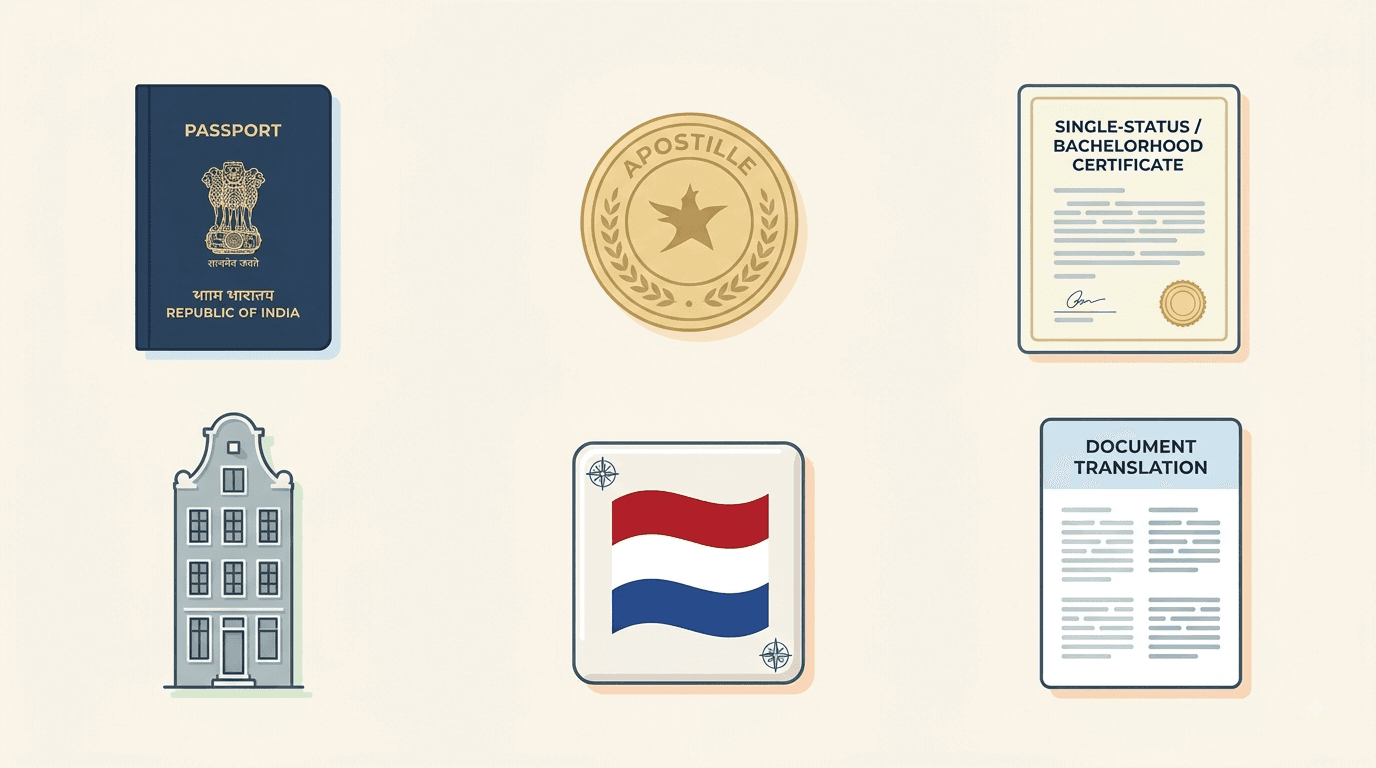
If you're an NRI planning to marry in the Netherlands — whether you're settling into a Dutch gemeente, joining a partner already living there, or simply choosing Amsterdam or Rotterdam as your wedding city — there's one document that will decide whether your marriage application moves forward or stalls at the counter: the bachelorhood certificate. Dutch civil registrars call it the Verklaring van Huwelijksbevoegdheid, but Indian applicants usually know it by a different name entirely, and that mismatch in terminology is exactly where most delays begin.
This guide walks through what the certificate actually is, why the Dutch system demands it, how the process works from the Indian side, and what NRIs specifically need to watch out for at each stage.
What Is a Bachelorhood Certificate?
In India, a bachelorhood certificate — also called a Single Status Certificate, Unmarried Certificate, or Certificate of No Impediment — is an official declaration confirming that an individual has never married, or is currently free to marry following a divorce or the death of a spouse. It's issued through a layered process involving a notarised affidavit, verification by a local magistrate, and further attestation up the chain to the state and central government.
For NRIs, this certificate becomes the foundation document that proves, to a foreign registrar, that nothing in Indian records stands in the way of the marriage. Without it, Dutch municipalities generally have no way of verifying an applicant's marital history, since Indian civil records aren't accessible to them directly.
The Dutch Equivalent: Verklaring van Huwelijksbevoegdheid
On the Dutch side, the counterpart document is called the Verklaring van Huwelijksbevoegdheid, commonly translated as a Certificate of No Impediment (CNI). It confirms that, according to Dutch law, nothing prevents the applicant from marrying — and it's typically requested by Dutch citizens or residents who plan to marry abroad, or by municipalities checking a foreign partner's eligibility.
Here's the part that trips up many NRIs: this Dutch CNI is only issued to Dutch nationals or registered residents. An Indian citizen who has never lived in the Netherlands cannot obtain a Verklaring van Huwelijksbevoegdheid from a gemeente. Instead, the Indian partner needs to bring an equivalent document from home — the bachelorhood certificate — properly attested and translated, to satisfy the same legal function.
Why the Netherlands Requires This Documentation
Dutch marriage law is built on the principle that both partners must independently prove their legal capacity to marry, regardless of nationality. Since Indian civil registration doesn't feed into any Dutch or EU database, the burden of proof shifts to the applicant. Your bachelorhood certificate becomes that proof — a government-backed statement, verified through multiple layers of Indian authority, that stands in for a record Dutch officials would otherwise have no way to check.
This is also why the certificate isn't accepted indefinitely. Dutch authorities generally treat civil status documents as valid only within a limited window from the date of issue, so timing your application against your intended wedding date matters more than most couples expect.
Who Needs This Certificate
If you're an Indian citizen or an NRI — married status unresolved in the eyes of Dutch authorities — and you plan to:
-
Marry a Dutch national or resident at a Dutch gemeente,
-
Marry another Indian or third-country national in the Netherlands, or
-
Register a marriage that already took place elsewhere with Dutch civil authorities,
you will very likely be asked to produce a bachelorhood certificate from India, properly legalised for use abroad.
Dutch nationals themselves don't need this Indian document — they simply request their own Verklaring van Huwelijksbevoegdheid from their local municipality. It's the Indian partner's documentation that goes through the longer, multi-step verification chain.
How NRIs Obtain a Bachelorhood Certificate from India
NRIs don't need to fly back to India to start this process. Most applicants complete it through one of two routes:
Through a Power of Attorney in India. You authorise a trusted representative — often a family member or a legal service provider — to handle the notarisation and government attestation steps on your behalf while you remain abroad.
Through the Indian Embassy or Consulate in your country of residence. Many Indian missions abroad, including in the Netherlands, offer a Single Status Certificate service directly, where you submit a sworn declaration and identity proof in person and the consulate issues the certificate itself.
Either route eventually leads to the same outcome: a certificate that has passed through notarisation, magistrate-level verification, and state or central government attestation, ready for its final authentication step.
Step-by-Step: The Certificate Process
-
Draft the affidavit. A notarised affidavit is prepared declaring your unmarried (or legally free) status, including personal details and, where applicable, information about a former marriage that has since ended.
-
Notarisation. A notary public formally attests the affidavit at the local court level.
-
Magistrate or Sub-Divisional Magistrate (SDM) attestation. The affidavit moves up for verification by a magistrate, adding a layer of government authentication.
-
State Home Department attestation. Some states require an additional round of verification before the document can proceed to central attestation.
-
MEA Apostille. Since India is a signatory to the Hague Apostille Convention, the certificate receives an Apostille stamp from the Ministry of External Affairs, making it recognisable across all Convention member countries — the Netherlands included.
-
Embassy attestation, if required. In some cases, an additional attestation by the Dutch mission in India (or the Indian mission in the Netherlands) may be requested, depending on the specific gemeente's requirements.
-
Certified Dutch translation. Since the certificate is issued in English, most Dutch municipalities will still expect a certified translation into Dutch, carried out by a sworn translator recognised in the Netherlands.
Documents You'll Typically Need Alongside It
Along with the bachelorhood certificate, Dutch municipalities commonly ask for:
-
A valid passport for both partners
-
A recent birth certificate, apostilled and translated
-
Proof of address or BRP (Basisregistratie Personen) registration, where applicable
-
Divorce decree or spouse's death certificate, if either partner was previously married
-
A personal declaration confirming the marriage isn't solely intended to obtain a residence permit — required for non-EU nationals in many cases
Requirements can vary meaningfully between municipalities, so it's worth checking directly with the specific gemeente where you intend to register, rather than assuming a uniform national process.
The Role of the Gemeente in Your Marriage
The gemeente — the Dutch municipal authority — is where the actual legal marriage process is administered. Whether you're registering an upcoming wedding or recording a marriage that already happened abroad, the gemeente reviews your documentation, confirms eligibility, and ultimately issues the official Dutch marriage record.
Choosing the right municipality matters, particularly for NRIs who don't have an existing Dutch address. Some gemeentes have specific procedures for non-resident applicants, and processing times can differ depending on how familiar the local registrar is with foreign document verification.
Ondertrouw: The Dutch Notice of Intended Marriage
Before any wedding ceremony in the Netherlands, couples must complete a step known as ondertrouw — a formal notice of intended marriage submitted to the municipality. Historically similar to the reading of banns, ondertrouw today functions as an administrative declaration rather than a public announcement, and it must be filed with the gemeente ahead of the ceremony, with your bachelorhood certificate and other documents in hand.
Common Mistakes NRIs Make
-
Applying for the certificate too early. Because civil status documents have a limited validity window, getting the certificate months before your travel or wedding date can mean it expires before it's used.
-
Skipping the Apostille. A bachelorhood certificate without an MEA Apostille generally won't be accepted by Dutch authorities, no matter how thoroughly it was notarised in India.
-
Assuming English is enough. Even though many Dutch officials speak English, most gemeentes still require an official Dutch translation for the civil registry file.
-
Not confirming the specific gemeente's checklist. Municipal requirements can differ, especially for applicants who've never lived in the Netherlands.
-
Underestimating processing time. Between notarisation, attestation, Apostille, and translation, the full certificate process can take several weeks — longer during peak periods.
Typical Timeline and Costs
For NRIs going through the full attestation chain, the bachelorhood certificate process usually takes a few weeks from the initial affidavit to a fully apostilled, translation-ready document. Costs vary depending on whether you handle the process yourself or through a legal service provider, and whether embassy attestation is additionally required. On the Dutch side, municipal certificate fees are comparatively minor, but they add up alongside translation and courier costs when documents are moving between two countries.
Final Thoughts
For NRIs, the bachelorhood certificate is often the single most time-consuming part of planning a Dutch marriage — not because any one step is especially difficult, but because it involves coordinating Indian and Dutch bureaucracy across borders, time zones, and languages. Start the certificate process early, keep the certificate's validity period in mind when scheduling your wedding, and confirm the requirements directly with your chosen gemeente rather than relying on general assumptions.
Get that piece of paperwork right, and the rest of your Dutch marriage process — from ondertrouw to the ceremony itself — tends to move much more smoothly than the reputation of Indian bureaucracy might suggest.