
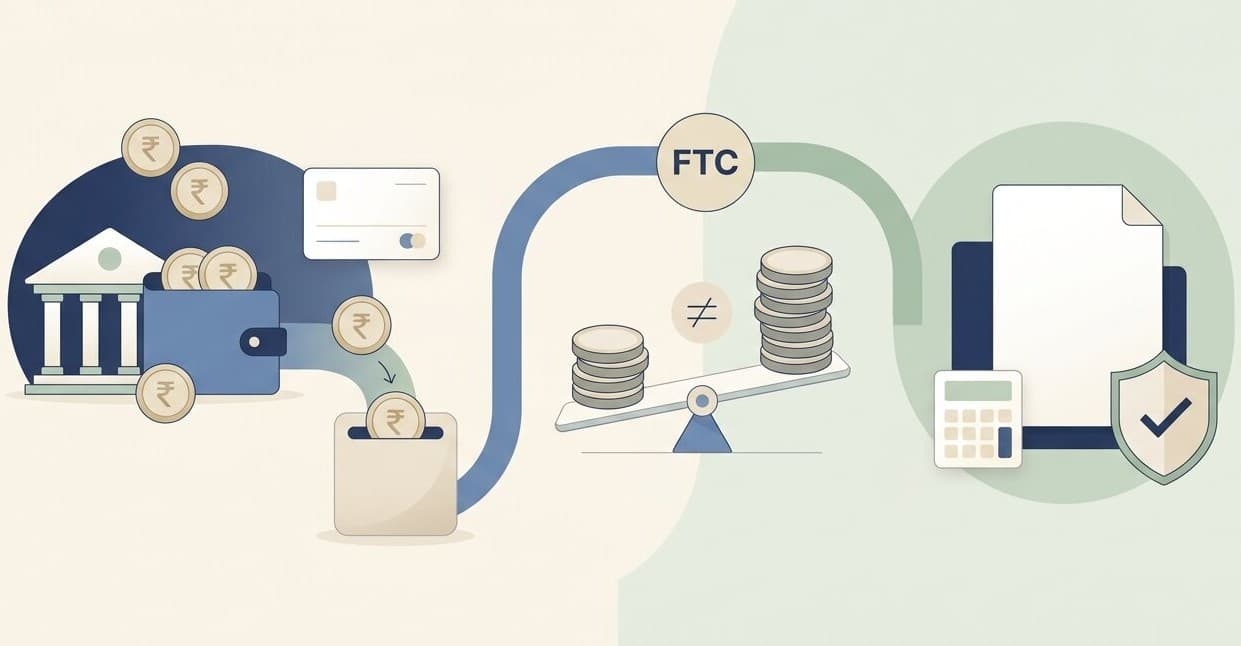
The situation: Kavita, a US citizen married to an Indian national, moved to Hyderabad in 2015 for her husband's career and continued earning consulting income, paid entirely in India, taxed entirely in India. She reasoned, sensibly enough on the surface, that she couldn't possibly owe the US anything — she'd already paid tax on every rupee she earned. She filed no US returns for eight years.
Where the reasoning breaks down: the US is one of a very small number of countries that taxes based on citizenship, not residency. A US citizen or green card holder owes US tax on worldwide income regardless of where they live or how much tax they've already paid elsewhere — the obligation to file exists independently of whether any additional tax is actually owed after credits.
What actually reduces the bill — the Foreign Tax Credit (FTC): dollar-for-dollar credit against US tax for foreign tax already paid on the same income, which for most NRIs in India's tax bracket structure eliminates most or all of the incremental US tax owed on Indian-source income. The Foreign Earned Income Exclusion offers a separate, alternative mechanism for excluding foreign wages up to an annually adjusted threshold, though FTC is often more favorable for higher earners or where Indian tax rates exceed US rates on the same income band.
What Kavita's case actually cost her: almost nothing in incremental tax, thanks to FTC — but the filing gap itself still required the full streamlined process: 3 years of returns, 6 years of FBARs on her Indian accounts, and a non-willfulness certification explaining a genuinely common, good-faith misunderstanding.
Why this misconception is so persistent among NRIs specifically: unlike expats from most other countries, Indian-origin US citizens and green card holders often have an entire family financial ecosystem in India — joint accounts, family business interests, inherited property — making "I already pay Indian tax" feel intuitively like the whole story. It isn't. Filing and owing are two separate questions, and the reporting obligation exists even in years where the actual US tax bill turns out to be zero.