
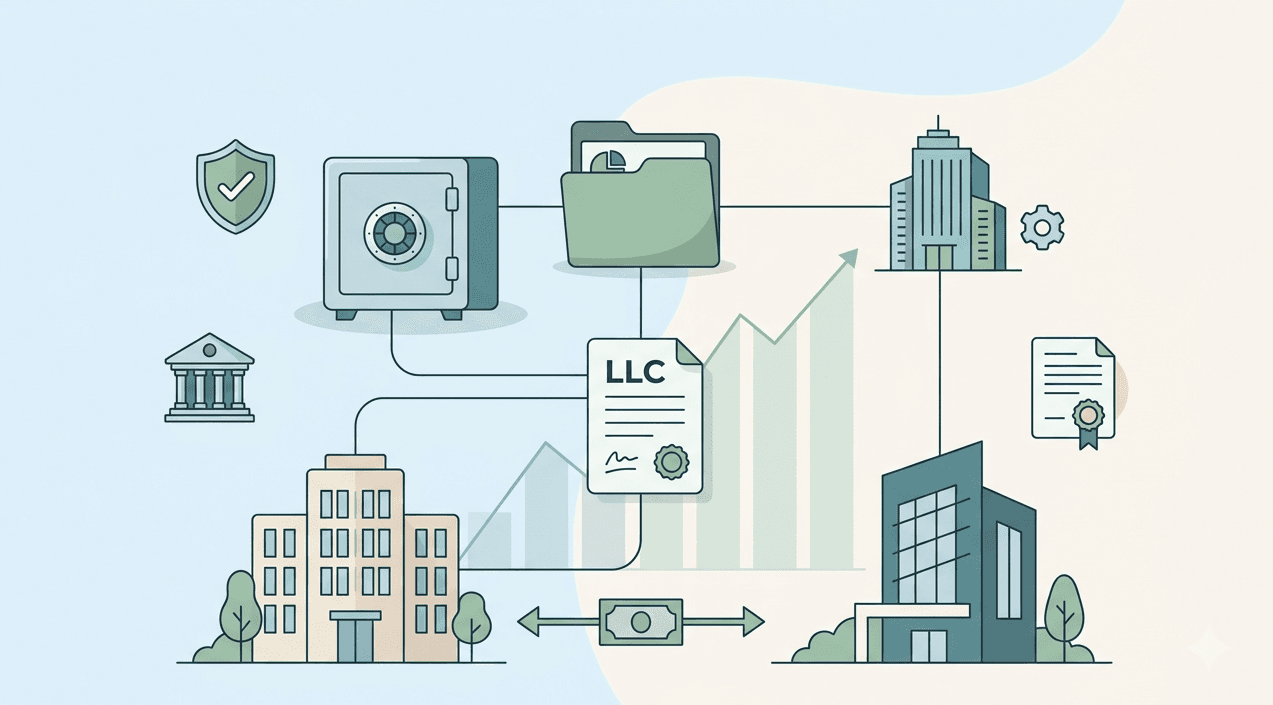
If you're an NRI sitting on a US retirement account and eyeing business or investment opportunities back home, there's a structure most Indian tax advisors never mention — and most US retirement custodians barely explain: using your Self-Directed IRA (SDIRA) or Checkbook IRA (IRA/LLC) to fund company incorporation in the USA, with a pathway to route that capital into company formation and investment in India — all while staying compliant with IRS rules, FEMA, and RBI reporting requirements.
This is a niche but powerful strategy for NRIs who want their US retirement funds working across two of the world's largest economies — without triggering unnecessary tax leakage on either side.
What is a Self-Directed IRA (SDIRA)?
A Self-Directed IRA is an IRA (Traditional, Roth, SEP) that allows you to invest beyond stocks, bonds, and mutual funds — into alternative assets such as real estate, private companies, startups, promissory notes, and precious metals. The IRS doesn't publish a list of allowed investments — it only restricts a handful: life insurance and collectibles. Everything else, including private company shares and LLC interests, is fair game.
What is a Checkbook IRA (IRA/LLC)?
A Checkbook IRA, also called an IRA/LLC or Checkbook Control IRA, takes the SDIRA concept a step further. Instead of routing every transaction through a custodian, your IRA owns 100% of a specially structured LLC, and you — the IRA holder — act as the non-compensated manager of that LLC. This gives you:
- Checkbook control — write checks, wire funds, and execute deals directly from the LLC's bank account
- Speed — no waiting on custodian approvals for time-sensitive opportunities
- Lower transaction costs — fewer per-asset custodian processing fees
- Operational flexibility — the LLC can enter contracts, open accounts, and transact internationally
For NRIs looking to deploy retirement capital into cross-border ventures, this structure is often the practical entry point — because the IRA-owned LLC, not the custodian, becomes the actual investing and contracting entity.
Company Incorporation in the USA Using SDIRA/Checkbook IRA Funds
Here's how the structure typically works:
Your IRA funds establish a single-member LLC, wholly owned by the IRA (not by you personally)
You are appointed the non-compensated manager — you direct investments but derive no personal compensation or benefit
The LLC, treated as a disregarded entity for federal tax purposes, opens its own bank account and can:
- Invest in private company shares and startup equity
- Fund a new US company (LLC or C-Corp) as a capital contributor
- Enter into international contracts and open foreign accounts where permitted
Key AdvantagesTax-deferred or tax-free growth: Traditional SDIRA gains grow tax-deferred; Roth SDIRA gains can be entirely tax-free at qualified distribution - Access to private markets: Startup equity, private placements, and operating businesses that traditional IRAs can't touch
- Asset protection: The LLC wrapper limits personal liability exposure
- Speed and control: Act on opportunities without custodian lag
- Diversification beyond Wall Street: Real businesses, real estate, and cross-border ventures — not just public securities
The Compliance Guardrails You Cannot Ignore
This structure is powerful, but the IRS enforces strict prohibited transaction rules under IRC Section 4975:
- Your IRA/LLC cannot invest in a business you or a disqualified person (spouse, parents, children) already owns or controls
- The manager (you) cannot draw a salary or personal benefit from the LLC
- No personal use of LLC assets, and no commingling of personal and IRA funds
- Investments that use leverage or generate active business income may trigger Unrelated Business Taxable Income (UBTI) or
- Unrelated Debt-Financed Income (UDFI) — both of which carry their own tax filing obligations even inside a retirement account
Getting this wrong doesn't just cost a penalty — it can disqualify the entire IRA, converting the full account balance into immediately taxable income. This is precisely where professional structuring — not DIY formation — protects the value of the account.
Structuring the India Leg: How the Capital Flows In
Once the US LLC (IRA-owned) is holding capital or private company interests, the natural next question for NRIs is: can this same capital fund or invest in a company in India? The answer is yes — but it must be structured correctly under India's foreign investment framework.
The FEMA and FDI Framework
Any investment by a US entity (including an IRA-owned LLC) into an Indian company is treated as Foreign Direct Investment (FDI) under the Foreign Exchange Management Act (FEMA), 1999, and the Non-Debt Instruments (NDI) Rules, 2019. Two routes apply:
RouteWhat It MeansAutomatic RouteNo prior government approval — covers most sectors including IT, software, manufacturing, and services, up to 100% FDIGovernment RoutePrior approval required for sensitive sectors (defence beyond thresholds, print media, multi-brand retail, etc.)
For most NRI-promoted businesses — technology, consulting, services, e-commerce (B2B), manufacturing — the Automatic Route applies, meaning capital can flow in without pre-approval, subject to post-investment reporting.
Mandatory RBI/FEMA Filings
Once funds are remitted and shares allotted to the foreign entity (your IRA-owned LLC or its downstream structure), the Indian company must:
- File Form FC-GPR on the RBI's FIRMS portal within 30 days of share allotment
- Ensure shares are allotted within 180 days of receiving the inward remittance
- File the Annual Return on Foreign Liabilities and Assets (FLA) every year by 15 July, even in years with no new inflow
- Obtain a valuation certificate from a Chartered Accountant or SEBI-registered valuer, since FDI pricing must meet Fair Market
- Value norms — shares cannot be issued below FMV
- Maintain KYC and FIRC (Foreign Inward Remittance Certificate) documentation from the remitting bank
Why This Structuring Matters
Missing the FC-GPR deadline, mispricing shares, or skipping the annual FLA return doesn't just risk a penalty — it creates a compliance red flag that surfaces during any future funding round, audit, or due diligence exercise, and can require a lengthy RBI compounding process to resolve.
Why NRIs Are Increasingly Exploring This Route
Retirement capital that would otherwise sit idle in US markets gets deployed into ventures the NRI actually understands — often in their home market
- Tax-advantaged growth inside the IRA structure, layered with correctly structured FDI into India
- A single framework that lets an NRI build, fund, and formalize a business presence in both the US and India, using one pool of retirement capital as the anchor
This is not a plug-and-play DIY project. It sits at the intersection of US retirement account law, IRS prohibited transaction rules, Indian company law, FEMA/RBI reporting, and cross-border tax treaty considerations — and a misstep on any one front (IRA disqualification on the US side, or FEMA contravention on the India side) can be costly and difficult to reverse.
How We Help
At India for NRI, we specialize in exactly this intersection — helping NRIs and US-based Indian-origin investors structure their SDIRA/Checkbook IRA-backed ventures into fully compliant US and Indian corporate entities, with the right FEMA reporting, valuation, and tax treaty positioning built in from day one.
If you're holding a Self-Directed IRA or Checkbook IRA and considering deploying that capital into a business or investment in India, talk to us before you move a single dollar. The structuring decisions made at formation are far easier — and far cheaper — to get right the first time than to unwind later.
Get in touch with our team to discuss how your SDIRA/Checkbook IRA can be structured for compliant, tax-efficient company incorporation across the US and India.